
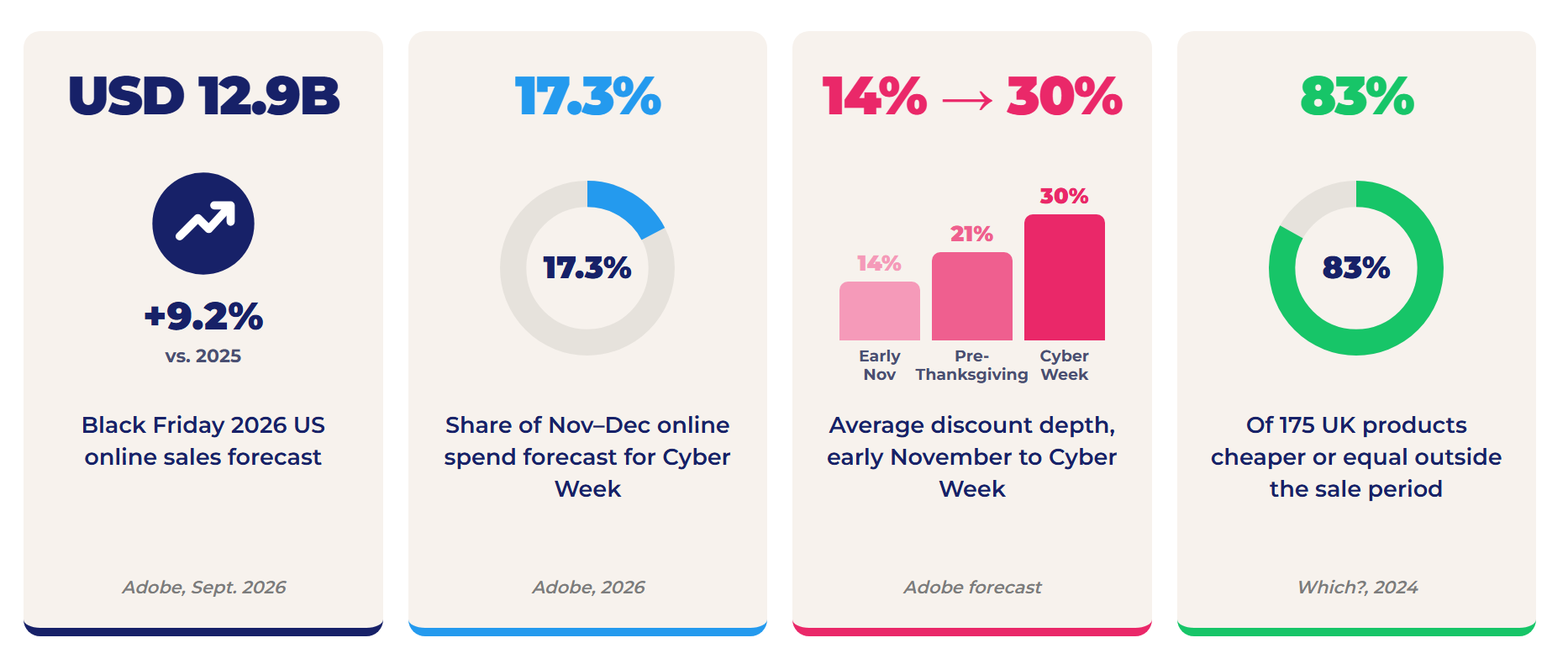
Black Friday pricing wars set the terms of the most contested week in retail. Adobe forecasts US online sales of USD 12.9 billion for Black Friday 2026, up 9.2%, with discounts deepening from 14% off in early November to 30% off once Cyber Week starts. A holiday pricing strategy that reads the market once a day meets a calendar in which every step is a repricing decision. This guide gives retail executives three tools to win Black Friday pricing wars without a margin bloodbath: a war room cadence, a margin-versus-competitiveness matrix and a post-event markdown review.
This is the third guide in Scraping Pros’ peak-season series. The first, on price monitoring software and tracking frequency, introduced the Price Volatility Index (PVI). The second, on MAP monitoring at scale, covered the brand’s own channel. This one turns both into an operating model for the executive who owns the number in the Black Friday pricing wars.
1. Why Black Friday Pricing Wars Break Normal Pricing Cadence
A normal pricing cadence assumes a market that moves slower than the team watching it. Black Friday pricing wars reverse that assumption. Adobe’s 2026 forecast shows the discount curve rising in steps: 14% off in early November, 21% off just before Thanksgiving and 30% off once Cyber Week begins. Each step is the sum of repricing decisions made by competitors who are working toward the same calendar.
The structural baseline was already moving. Alberto Cavallo’s NBER research found that the share of prices changing each month at large multi-channel US retailers rose from 15% in 2008–2010 to nearly 30% in 2014–2017, with the sharpest increase in electronics, where online competition is strongest. Peak week puts that dynamic under a deadline.
Scraping Pros measures this movement with the Price Volatility Index (PVI): the median number of hours between observed price changes per SKU, aggregated by category and compared between a baseline period and peak-season weeks. The price monitoring guide showed why capture frequency matters: a daily snapshot records at most one change per day, however many changes actually happened. Effective black friday price monitoring starts by establishing how fast each category moves, then sets the cadence.
The peak is a calendar of category moments
Adobe expects the deepest discounts to land on different days depending on the category. In Black Friday pricing wars, a single war room posture applied to every category spends attention where the market is quiet and misses it where the market is moving.
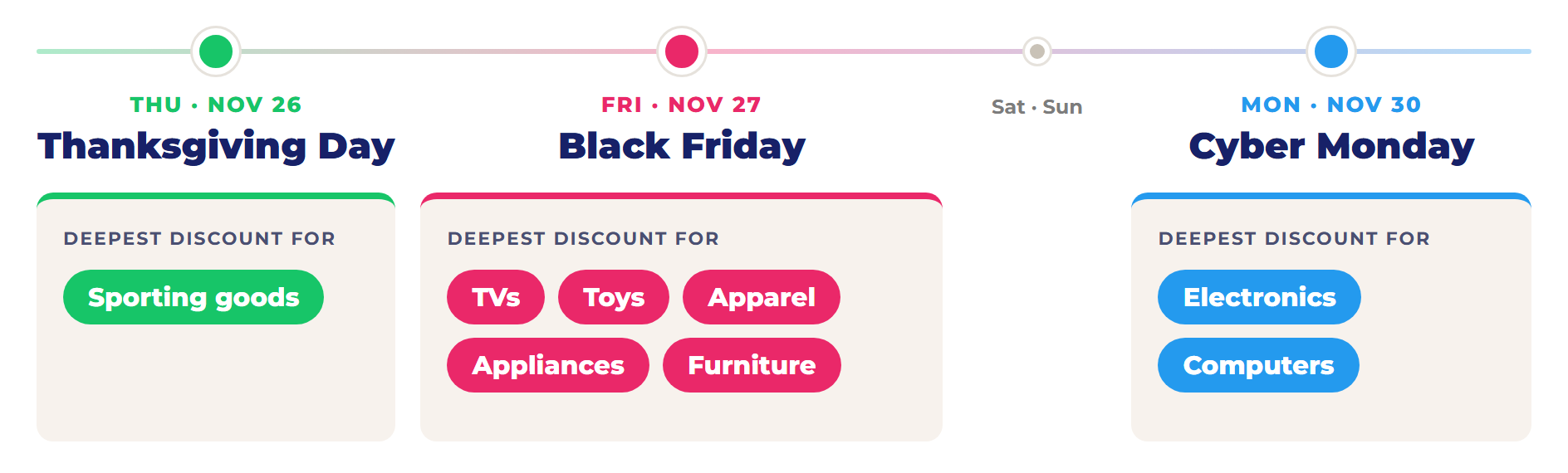
Source: Adobe Digital Insights, 2026 holiday forecast. In 2025, Adobe recorded peak Cyber Monday discounts of 31% in electronics, 28% in toys and 25% in apparel.
Knowing the calendar is the easy part. Section 3 contains the matrix that decides which competitor moves deserve a response and which ones start a race to the bottom.
2. Building a War Room for Black Friday Pricing Wars
A war room runs on three clocks: the monitoring clock (how often the market is observed), the decision clock (how long until someone with authority chooses) and the execution clock (how long until the new price is live). The slowest of the three sets the real response time. The earlier price monitoring guide made the same point from the data side: hourly capture adds cost without changing outcomes if the organization can only respond once a day.
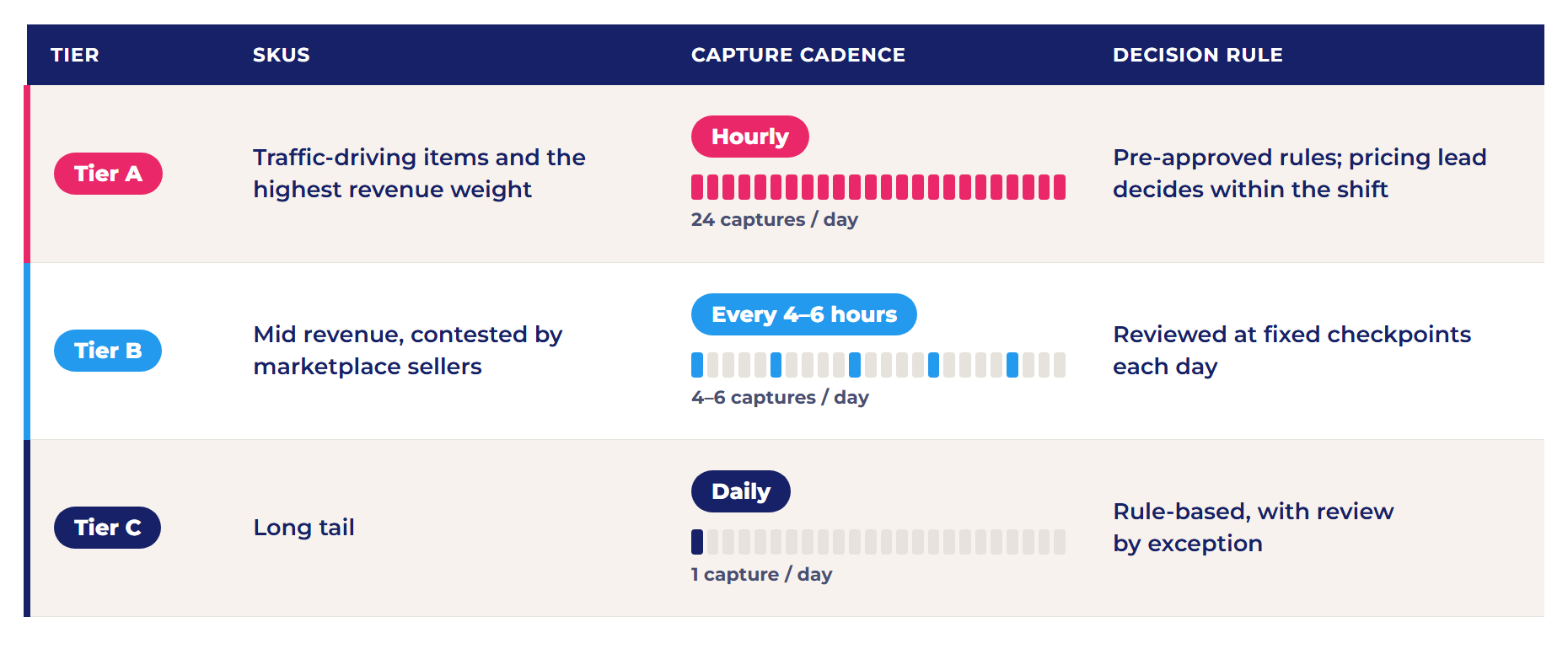
Capture cadence by SKU tier
The operating rule below is Scraping Pros’ recommendation for peak week. Within each tier, the capture interval should also follow the PVI: at least two or three captures inside the shortest repricing interval observed for the category.
Roles and alerts
- Pricing lead: owns decisions and approves any exception to a floor price.
- Data analyst: validates alerts and product matching before a price change is proposed.
- Merchandising and inventory: reports stock position and supplier funding available for a response.
- Finance: guards the weekly margin cap.
- Brand and channel owner: handles MAP and unauthorized-seller cases through the confirmation process described in the MAP guide.
Four alert types cover the week: a competitor move on a Tier A SKU, a competitor out of stock, a seller below MAP or outside the authorized network, and an own price outside its agreed band. MAP and listing alerts follow the Listing Violation Funnel: a violation is confirmed with a second capture before anyone acts on it. A decision log records every price change with its owner, its trigger and its expiry.
3. Protecting Margin Without Losing Black Friday Pricing Wars
A response rule, the core of any dynamic pricing strategy in peak week, needs two inputs: how competitive the price is and how much margin it leaves. Crossing them produces four zones, each with a different instruction for the war room.
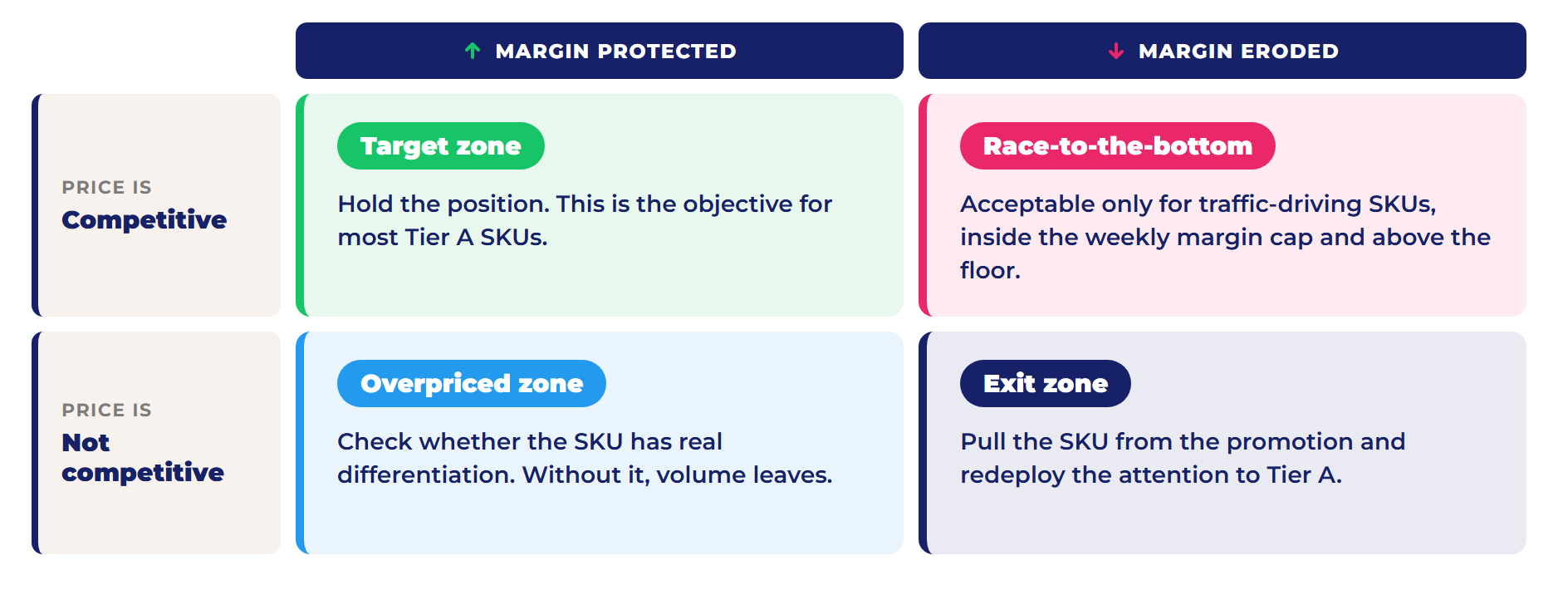
Scraping Pros decision framework for Black Friday pricing wars.
Six decision rules
- Set the floor before the week: every Tier A SKU has a floor price, approved by Finance in advance.
- Match selectively: respond to competitor moves on traffic-driving SKUs and hold on the rest.
- Skip out-of-stock competitors: a price on a unit that cannot be bought is not a competitive price.
- Skip prices below MAP: matching a listing that violates MAP moves the violation into the brand’s own channel.
- Use non-price levers: bundles, delivery terms and warranty extend the offer without lowering the price.
- Cap the margin given up: one weekly number, reviewed every day.
Price history is also audited in public. A Which? study tracked 175 products at eight major UK retailers for a year around Black Friday 2024 and found that 83% were cheaper or equal in price on at least one occasion outside the four-week sale period. An executive with a complete price record can verify a promotion before a third party does.
A rule worth adopting in every holiday pricing strategy, and the one that keeps Black Friday pricing wars from turning into a margin bloodbath: no price match goes live without a named floor, a named owner and an expiry time.
4. What Changes the Week After
Adobe forecasts Cyber Monday as the biggest online day of the season at USD 15.1 billion, so cyber monday pricing closes the peak and the review starts the next morning. The Black Friday pricing wars end on the calendar, but the data they leave behind is the starting point for next season. Three activities define the week after.
- Markdown tracking: follow the depth and duration of residual discounts across the assortment, and detect which competitors reset prices and which keep discounting into December.
- A four-metric post-mortem: windows missed (alerts not answered inside the decision clock), margin given up against the cap, price-match events by tier, and false-positive alerts.
- PVI baseline update: peak-week observations become the new reference for the next peak. Categories that moved between PVI bands this week start the next season with a higher cadence.
The same model applies to the regional peaks in Latin America, such as Hot Sale and CyberMonday in Argentina, Buen Fin in Mexico and Black Friday Brasil. The calendar changes by country. The three clocks, the tiers and the matrix stay the same.
Action Items
- Rank SKUs into tiers by revenue weight: assign each tier a capture cadence before the week starts.
- Set a floor price and an owner for every Tier A SKU: get Finance sign-off on one weekly margin cap.
- Measure the three clocks in hours: capture, decision and execution. The slowest one is the response time.
- Separate MAP alerts from competitor-price alerts: so a matching rule never follows a violation.
- Schedule the post-event review now: markdown tracking, the four post-mortem metrics and the PVI baseline update.
