
What is a MAP violation, and how does MAP monitoring catch one at scale? A MAP violation occurs when a reseller advertises a product below the brand’s minimum advertised price. MAP monitoring detects it by matching every listing to the catalog and checking it against the policy. Marketplaces police counterfeits at scale: Amazon removed more than 15 million counterfeit products in 2025. Enforcing an advertised-price policy, and the MAP monitoring behind it, remains the brand’s job.
A previous Scraping Pros guide on price monitoring software covered how often competitor prices change and how to set a capture frequency by category. That guide looked outward, at the market. This one applies MAP monitoring to the brand’s own distribution: the resellers, marketplaces and listings that carry its products. During peak sales events such as Black Friday, a single listing below MAP can spread fast. Other resellers match it, margins compress across the channel, and authorized dealers start questioning whether the policy is enforced at all.
What Counts as a MAP or Listing Violation
A minimum advertised price (MAP) policy is a rule a brand publishes to set the lowest price at which resellers may advertise its products. Its scope is the advertised price. The final sale price falls outside it. As the law firm K&L Gates explains, a retailer that advertises below MAP in a newspaper breaches a MAP agreement, while charging less inside its own store does not.
That distinction shapes MAP monitoring. Every clause of the policy has to become a rule a system can check. Which surfaces count as advertising: product pages, shopping feeds, paid ads, email campaigns? Does shipping count toward the price? Do coupons applied on the page? Is there a tolerance band? A vague policy produces vague alerts, and vague alerts produce false accusations. Scraping Pros calls this step policy-to-rule translation, the first step of any MAP monitoring program, and it comes before any data is collected.
Effective MAP compliance monitoring covers four types of violation, which together define the scope of listing integrity monitoring:
- Advertised price below MAP. The core case, on any surface the policy covers.
- Unauthorized seller. A storefront outside the approved distribution network, often the first sign of gray-market stock.
- Altered listing. Outdated specifications, wrong images or modified titles that misrepresent the product.
- Counterfeit signal. An abnormally low price combined with inconsistent listing content. Price alone is an indicator, never proof.
Platforms invest heavily in the last category. Amazon reports that its proactive controls block more than 99% of suspicious listings before a brand can detect and report them. Those programs are built around intellectual property and counterfeits. A MAP policy is a private rule between a brand and its resellers, so marketplace monitoring for brand protection has to cover pricing policy as well, and that work sits with the brand.
How MAP Monitoring Works at Thousands-of-Listings Scale
Scale changes the MAP monitoring problem. A brand with 400 SKUs sold through 15 retailers and marketplaces, with an average of five sellers per product, generates around 30,000 listing observations per capture cycle. During peak season, when MAP alerts may need hourly cadence, manual review stops being an option.
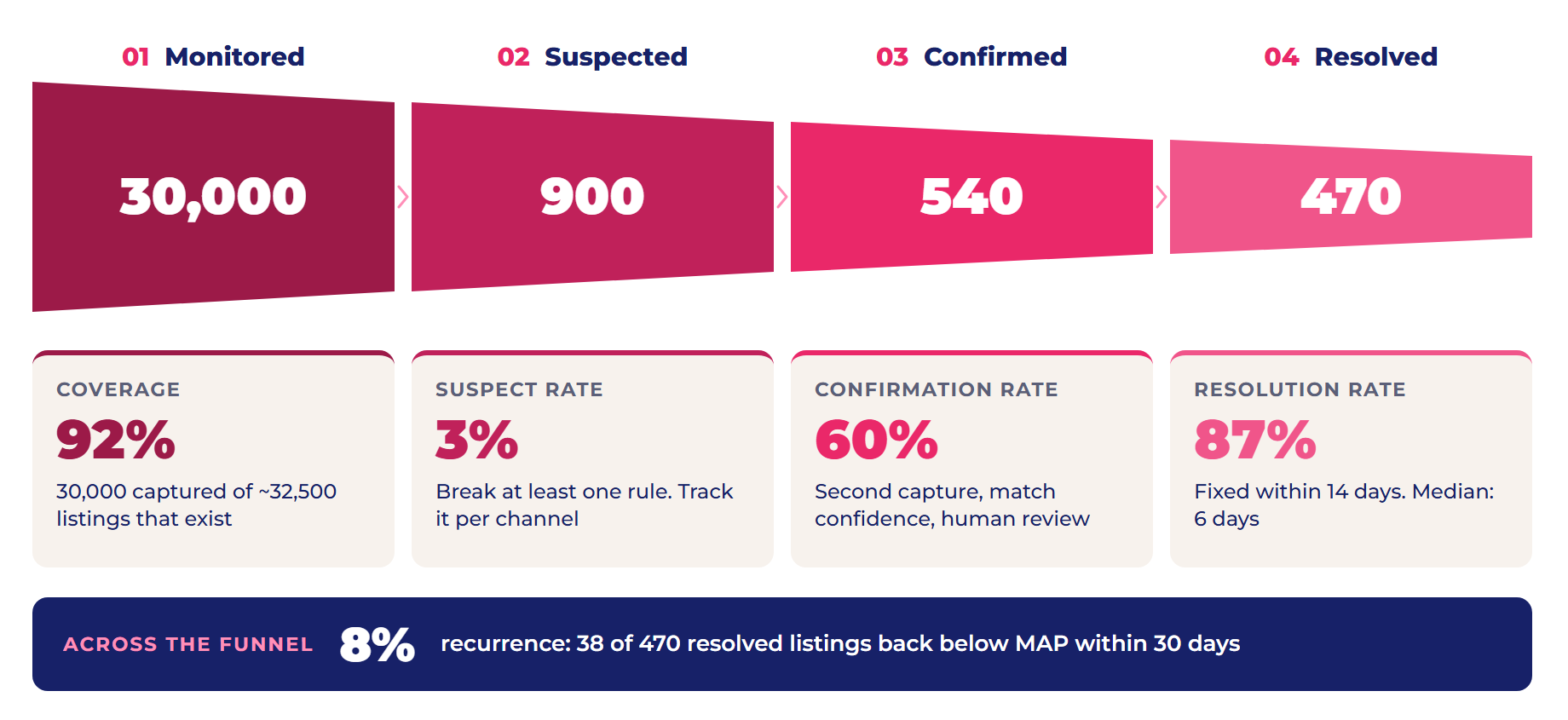
Scraping Pros structures MAP monitoring as the Listing Violation Funnel, a four-stage method in which each stage filters noise and has its own metric. Applied to the illustrative brand described above, a single capture cycle might move through the funnel like this:
- Monitored. Every listing that carries the brand is captured and matched to the catalog. Metric: coverage, the share of the brand’s real channel footprint actually observed (listings captured ÷ listings estimated to exist). Example: 30,000 listings captured out of an estimated 32,500 gives 92% coverage. The missing 8% is where unmonitored violations live.
- Suspected. Listings that break at least one rule. Metric: suspect rate (suspected listings ÷ monitored listings), tracked per channel. Example: 900 suspects out of 30,000 gives a 3% suspect rate. A marketplace running at 7% while retailers sit near 1% shows where to focus.
- Confirmed. Suspects that pass verification: a second capture showing the price persists, a match confidence above threshold, and human review for edge cases. Metric: confirmation rate (confirmed violations ÷ suspects). Example: 540 confirmed out of 900 suspects gives 60%. The other 360 are short feed glitches, bundles mistaken for discounts, or authorized dealers missing from the dealer list. Without this stage, all of them would have received a notice.
- Resolved. Confirmed violations corrected or removed, verified by a new capture. Metric: resolution rate within the target window and median time to resolution. A practical target is 14 days from confirmation. Example: 470 of 540 cases resolved within 14 days gives an 87% resolution rate, with a median of 6 days. The remaining 70 move to the next escalation step.
A fifth metric runs across the whole funnel: recurrence, the share of resolved cases that come back. Example: 38 of the 470 resolved listings reappear below MAP within 30 days, an 8% recurrence rate, usually concentrated in a handful of sellers.
The confirmation stage deserves the most care. Recall matters at the top of the funnel, where nothing should be missed. At confirmation, precision matters more. An authorized dealer wrongly accused of breaking MAP is a damaged relationship, and inconsistent enforcement can weaken the legal footing of the policy itself. The second-capture rule filters out short glitches, such as a price that sits below MAP for minutes during a feed update.
Capture frequency follows the same logic described in the price monitoring software guide: the cadence must match how fast prices move in each channel. For MAP monitoring, the most volatile channels during peak weeks are usually marketplaces with many third-party sellers.
Matching Listings to Catch Unauthorized Sellers
Unauthorized reseller monitoring depends on two matching problems: identifying the product and identifying the seller. Seller matching is the harder of the two.
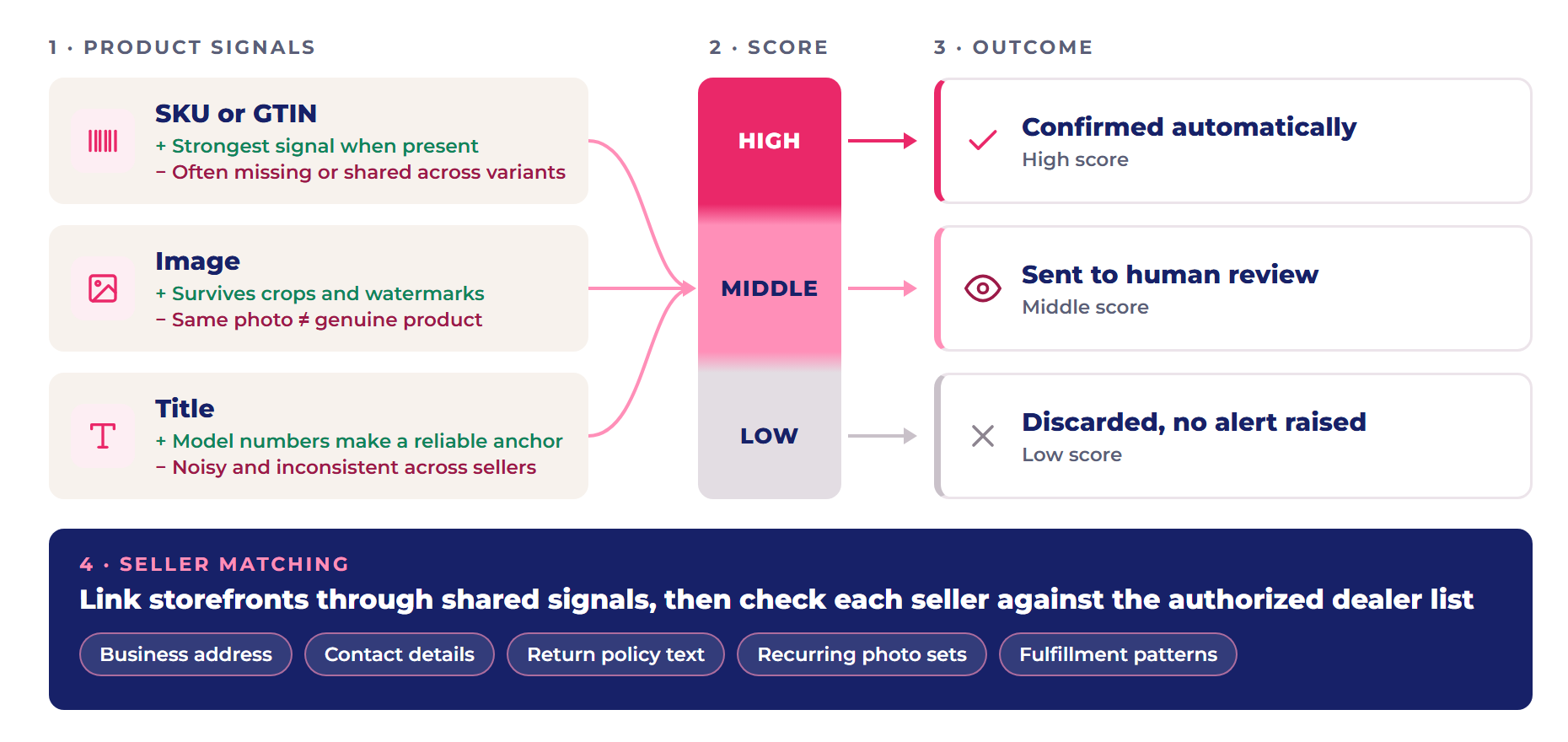
Product matching combines three signals, each with a known weakness:
- SKU or GTIN. The strongest signal when present, but marketplace listings may omit it, misuse it or share one code across variants.
- Image. Perceptual hashing recognizes a product photo even after cropping, resizing or watermarking. A matching image proves the photo is the same. It says nothing about whether the product is genuine, because counterfeit listings can reuse official images.
- Title. Noisy and inconsistent, but normalized model numbers make a reliable anchor.
No single signal is enough. The three combine into a confidence score with three outcomes: high scores confirm automatically, middle scores go to review, low scores are discarded. Bundles and variants are the main source of false positives in MAP monitoring. A kit that includes the product plus accessories can look like a deep discount when it is a different offer, and the matching layer must recognize it.
Seller matching closes the loop. A seller removed from one marketplace can reappear under a new storefront name. Resolving seller identity means linking storefronts through shared signals: business address, contact details, return policy text, recurring photo sets and fulfillment patterns. Without it, the funnel resolves the same violation again and again.
One reference table makes all of this work: the authorized dealer list. Every detected seller is checked against it. That list drifts over time, as approved dealers open new storefronts or change legal names. A stale dealer list is a direct source of false unauthorized-seller alerts, so its maintenance belongs inside the MAP monitoring program.
What Happens After a Violation Is Confirmed
MAP monitoring without a playbook produces a backlog. The escalation process runs in three phases.
Evidence. Each confirmed case gets a package: a timestamped capture of the page, the URL, the seller ID, the advertised price with and without shipping, and the policy clause it breaks. Evidence collected at the moment of detection holds up better than a screenshot taken days later, when the listing may have changed.
Notification. The reseller is notified in the terms the published policy defines, with escalation steps applied the same way to every reseller. Counterfeit and intellectual property cases follow a separate route through each marketplace’s brand protection programs.
Follow-up. A new capture verifies the correction. The case closes only when the data confirms it, and it moves to the recurrence log.
The legal frame matters as much as the process, and it changes by country. In the United States, MAP policies are generally lawful under federal law when structured as unilateral policies, a principle rooted in the 1919 Colgate doctrine. Since the Supreme Court’s 2007 Leegin decision, resale price agreements are assessed case by case under the rule of reason. State laws can be stricter: California, for example, treats resale price maintenance as per se unlawful.
The European Union takes a stricter line on resale price maintenance. In July 2018, the European Commission fined Asus, Denon & Marantz, Philips and Pioneer a total of €111 million for resale price maintenance in online sales. According to the Commission, the companies used monitoring tools to spot price cuts and then pressured or sanctioned retailers that did not comply.
The lesson for any brand operating across markets: MAP monitoring data is neutral, and the risk lies in how the brand acts on it. Escalation playbooks should be reviewed with legal counsel in each jurisdiction. This article does not constitute legal advice.
Action Items
- Audit the MAP policy text: each advertising surface, shipping rule, coupon rule and tolerance band becomes one detection rule.
- Estimate the brand’s real listing footprint and track coverage every capture cycle.
- Require two captures and a minimum match confidence before confirming any case.
- Update the authorized dealer list before each peak season, including new storefronts of approved dealers.
- Standardize the evidence package so every notice cites the same data and the exact policy clause.
- Report the five MAP monitoring metrics monthly and review the playbook with legal counsel in each market.
FAQ
What Counts as a MAP Violation?
An advertised price below the brand’s minimum advertised price, on any surface the policy covers.
How Do You Monitor Thousands of Listings Automatically?
MAP monitoring captures every listing, matches it to the catalog and filters suspects through confirmation.
What Happens After a Violation Is Detected?
Evidence is packaged, the reseller is notified under the policy, and a new capture verifies the fix.
How Is Channel Monitoring Different From Price Monitoring?
Price monitoring tracks competitors. Channel monitoring audits the brand’s own resellers and listings.
Is MAP Monitoring Legal?
Legal risk depends mainly on how the policy is enforced, and rules vary by country. Legal counsel should review both data collection and enforcement.
