
NLP web scraping starts where conventional extraction ends. Eighty-seven percent of the data available on the web lives inside language — buried in reviews, analyst commentary, forum threads, and news feeds that no regex pattern will ever cleanly parse. In our earlier analysis, AI Web Scraping: The Intelligence Revolution, we established how machine learning reshaped the automation layer of web extraction. This post builds on that foundation: the application of Natural Language Processing to transform raw text into structured, classified, decision-ready intelligence. What follows is the production architecture Scraping Pros has refined across global deployments — with performance figures from live systems.
1. NLP Pipeline Architecture
The core shift NLP introduces to web scraping is a change in the fundamental unit of extraction. Traditional scrapers work at the level of the DOM element. NLP-powered systems work at the level of meaning — not what an HTML node contains, but what concept a passage expresses and which components carry business value.
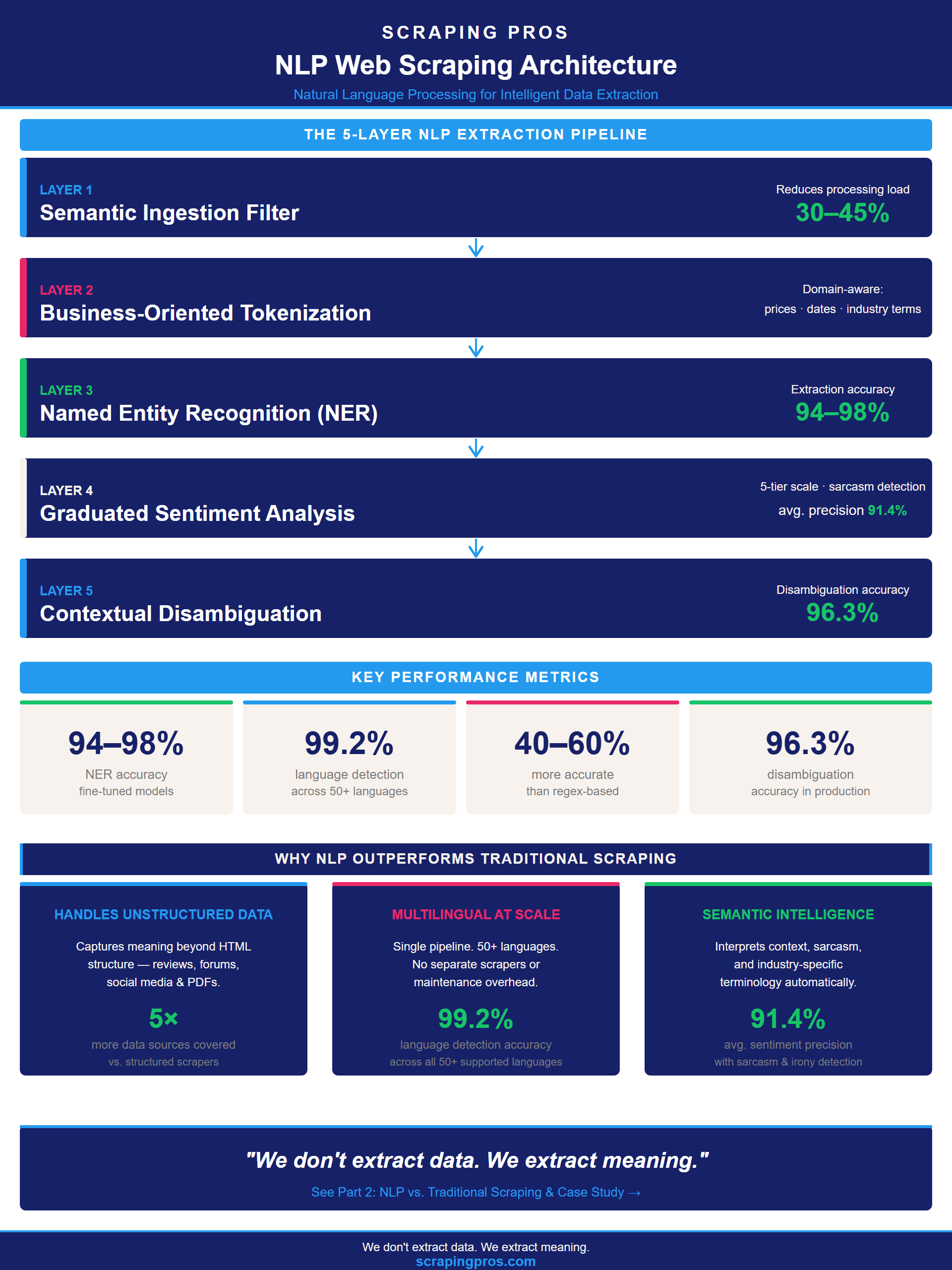
Scraping Pros structures this NLP web scraping pipeline around five sequential layers:
- Semantic Ingestion Filter — evaluates informational entropy across text blocks before any model processes them, eliminating boilerplate, navigation text, and footers. This reduces downstream processing load by 30–45% without sacrificing signal quality.
- Business-Oriented Tokenization — domain-aware tokenization that recognizes “$4,299” as a price entity, “Q3 2024” as a financial temporal marker, and “Series A” as venture-capital context — not generic linguistic units. This layer is what makes at scale both precise and resilient to source formatting changes.
- Named Entity Recognition (NER) — fine-tuned models achieving 94–98% accuracy on named entities. The key architectural decision: DOM context (a price element, an author byline) is used as a confidence signal alongside the linguistic classifier, producing labels that are both semantically accurate and structurally grounded. Open-source libraries like provide the foundational NER infrastructure that many production pipelines build on before domain-specific fine-tuning.
- Graduated Sentiment Analysis — a five-tier scale with intensity weighting, plus a sarcasm detection module trained on review corpora across English, Spanish, French, and Mandarin. A sentence like “essential if you enjoy paying for things that don’t work” is correctly classified as strongly negative.
- Contextual Disambiguation — resolves polysemous entities (“Apple,” “Mercury,” “Jaguar”) by cross-referencing the semantic neighborhood of the paragraph, the source domain, and a page-level context vector. Disambiguation accuracy in production: 96.3%.
- Architecture insight: The five layers are modular. Clients with existing NER infrastructure can integrate at Layer 3. Those who only need sentiment output receive a processed feed downstream of Layer 4.
2. Entity Recognition and Extraction
The precision gap between NLP-based extraction and pattern matching is structural. A regex rule for prices works until a source uses a non-standard currency symbol or a price range. A fine-tuned NER model identifies price entities by their linguistic role in the sentence — regardless of formatting variation. That resilience produces 40–60% better accuracy over regex-based approaches on unstructured text, measured across e-commerce, news, and financial data environments.
Production NER systems extract what the client’s business actually needs: product variants and SKUs, , regulatory identifiers, contract durations, and supplier-brand relationships. Each entity class requires a domain-specific training corpus — the 94–98% accuracy figure applies to production-tuned models within their target vertical. offers a reference point for the range of pre-trained NER architectures available before domain fine-tuning.
3. Sentiment Analysis Integration
Sentiment earns its place in a production NLP web scraping pipeline not as a label appended to a record, but as a signal that changes the economic value of the data. A price point tells you what something costs. Sentiment across ten thousand reviews tells you whether that price is defensible and which feature is eroding willingness to pay. This is the intelligence layer behind effective — understanding not just what is being said about a product, but how strongly and in what direction.
Multilingual and Culturally Aware
The system achieves 99.2% language detection accuracy across 50+ languages, but detection is only the first step. Culturally calibrated models handle the directness asymmetry between Japanese and German review conventions, Arabic’s formal/colloquial register split, Spanish diminutives used as intensity markers (“malísimo”), and code-switching in Southeast Asian text. This is what Scraping Pros calls culturally-aware scraping: language-native models that treat each linguistic context as its own analytical environment, not a translation step applied before analysis.
Average sentiment precision across all supported languages in production: 91.4%, with English, Spanish, French, and Mandarin consistently above 93%.
4. Semantic Web Scraping vs. Traditional Extraction
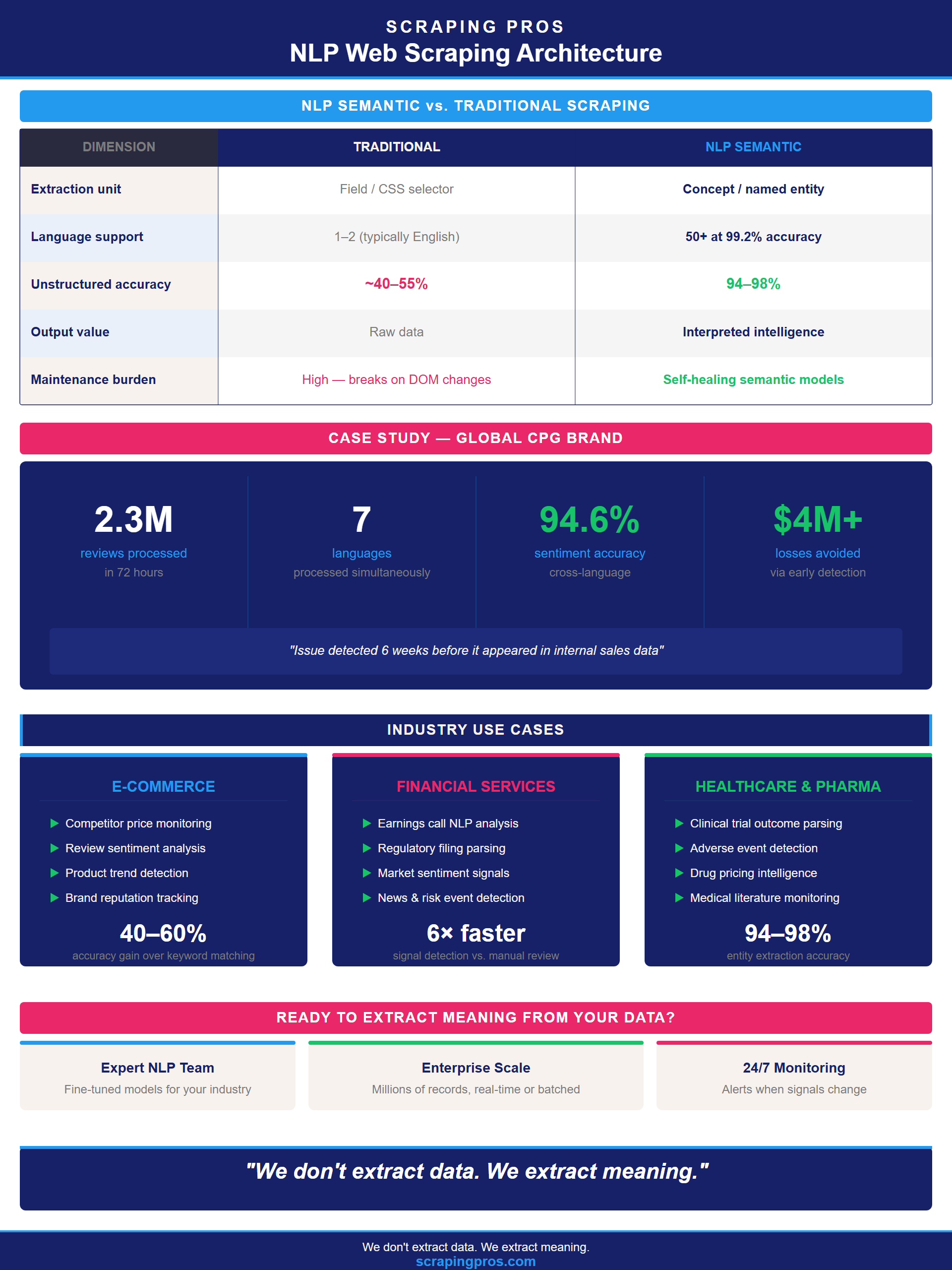
The distinction is architectural, not incremental. At Scraping Pros, we define semantic scraping precisely: we do not extract data. We extract meaning.
5. Case Study: 2.3 Million Reviews, 7 Languages, 72 Hours
A Global CPG Brand’s Real-Time Reputation Intelligence Challenge
The challenge: A global CPG brand operating across LATAM, Eastern Europe, and Southeast Asia needed to monitor brand perception across seven languages — Spanish, Brazilian Portuguese, Polish, Romanian, Indonesian, Tagalog-English, and Thai — in near real-time, from unstructured marketplace reviews and forums. Their previous vendor delivered data with a 10-day lag and binary sentiment only.
What we built: A full five-layer NLP pipeline fine-tuned for CPG review data. NER models mapped the client’s product names across three regional brand identities and multiple variant spellings to canonical entity IDs. The Thai and Tagalog-English pipelines required hybrid tokenization — off-the-shelf multilingual models produced 34% higher misclassification rates on these two languages; custom tokenization reduced that gap to under 6%. Sarcasm detection was enabled for Spanish and Portuguese after a corpus analysis found ironic expressions in 11.3% of negative reviews in those languages.
Results
- 2.3 million reviews processed across all sources in 72 hours
- 94.6% sentiment classification accuracy across all seven languages, verified against an 8,200-review human-annotated validation set
- 98.1% cross-language entity consistency — product mentions correctly resolved to canonical IDs regardless of language or spelling variant
- Six-week lead time: the system detected a deteriorating sentiment cluster around packaging durability in Indonesia six weeks before it appeared in the client’s internal sales and returns data
- Estimated avoided losses: >$4M, based on the client’s internal assessment of comparable incidents that reached media coverage before resolution
Key takeaway: The client shifted from a retrospective reporting model to a prospective intelligence model — not by building new internal capabilities, but by changing the quality of the data they received.
Is Your Data Strategy Ready for What Your Competitors Already Know?
If your organization is making decisions based on structured data alone, you’re working with a fraction of the intelligence available. Our specialists work directly with data, strategy, and technology leaders to assess extraction gaps and design NLP pipelines built for your industry and markets. Learn more about our or explore tailored to your vertical.
Schedule a consultation with a Scraping Pros specialist → scrapingpros.com/contact
Frequently Asked Questions
Q1: What is NLP web scraping and how does it differ from conventional scraping?
NLP web scraping applies language processing models to extracted text, enabling entity classification, sentiment scoring, and ambiguity resolution. Where conventional scraping extracts what is structurally present in the DOM, NLP scraping extracts what is semantically meaningful — a distinction that matters when data lives in reviews, articles, or any source where information is expressed rather than formatted.
Q2: What accuracy levels can be expected from NLP-based entity extraction?
With domain-tuned NER models, Scraping Pros consistently achieves 94–98% accuracy within the target vertical. The most critical variable is training corpus quality — generic multilingual models produce materially lower results on specialized entity classes like financial instruments or regulatory identifiers.
Q3: Can NLP scraping process multiple languages simultaneously without performance loss?
Yes. Language detection runs at 99.2% accuracy across 50+ languages, routing each document to language-native model instances so throughput scales without degradation.
Q4: Is NLP web scraping significantly slower than traditional approaches?
The processing layer adds latency, but two architectural decisions offset it: the semantic ingestion filter eliminates 30–45% of text before model processing, and deep-learning analysis is reserved for the 30% of records where ambiguity is present. In practice, clients move from weekly or monthly data cycles to daily or near-real-time.
Q5: Which industries get the most value from NLP-powered web scraping?
The highest-value applications are in sectors where unstructured language carries decision-relevant information: consumer goods, financial services, pharmaceuticals, and retail. Any organization currently relying on manual analyst review of text data is a strong candidate for NLP extraction infrastructure.
