
Data enrichment is the process of adding external information to the data you already own, such as customer records, product catalogs or lead lists, so it becomes more complete, accurate and useful for decision-making. Today the largest and most current source of that external information is the public web, and web scraping is how companies collect it at scale.
Most internal datasets are incomplete. A CRM may have names and emails but no company size. A product catalog may list SKUs but not competitor prices. A risk model may rely on application forms and ignore the signals that are published openly online every day. Enrichment closes those gaps.
In this guide we cover what data enrichment is, the main types, how a web scraping–based enrichment pipeline works step by step, where it creates the most value, and the practices that keep enriched data accurate and compliant.
What Is Data Enrichment?
Data enrichment combines a first-party dataset with relevant third-party or public data, matched to the same entity (a customer, a company, a product, a location). Sources include commercial data providers, public databases, APIs and, increasingly, data collected directly from websites through web scraping.
A simple before-and-after example for a B2B lead record:
| Field | Before enrichment | After enrichment |
|---|---|---|
| Company | Acme Logistics | Acme Logistics |
| Website | acmelogistics.com | acmelogistics.com |
| Industry | — | Freight & logistics |
| Employees | — | 200–500 |
| HQ location | — | Rotterdam, NL |
| Tech stack | — | Shopify, HubSpot |
| Hiring signals | — | 12 open roles in operations |
| Last news mention | — | Opened new warehouse (last month) |
The original record says who the lead is. The enriched record tells sales whether it is a good fit and why it may be the right time to reach out.
Enrichment is different from data cleaning. Cleaning fixes what is already in your dataset (duplicates, formatting errors, inconsistencies), while enrichment adds what is missing. In practice the two work together: clean first, enrich second, validate at the end.
Why Internal Data Is Not Enough
Internal data reflects only what customers and prospects have told you, and it starts going stale the moment it is captured. People change jobs, companies grow or shrink, prices move and competitors launch new products. Gartner has estimated that poor data quality costs organizations an average of USD 12.9 million per year, and incomplete or outdated records are a big part of that.
Enrichment brings in three things internal data rarely has:
- Context: market, industry and competitor information that describes the environment around each record.
- Freshness: signals that change daily, such as prices, stock levels, job postings, reviews and news.
- Coverage: attributes that customers never fill in on a form, but that are publicly available online.
Types of Data Enrichment
| Type | What it adds | Typical web sources |
|---|---|---|
| Firmographic | Industry, company size, revenue range, locations | Company websites, business directories, public registries |
| Demographic | Age range, income bracket, region (aggregated or consented) | Public statistics, census and open-data portals |
| Technographic | Software and tools a company uses | Website source code, job descriptions, integration marketplaces |
| Contextual | Market conditions around an event or record | News sites, social media, review platforms, economic indicators |
| Behavioral / preferential | Buying patterns, reviews, sentiment | Marketplaces, review sites, forums (public and aggregated data only) |
| Product & pricing | Competitor prices, availability, specs, ratings | E-commerce sites, marketplaces, retailer catalogs |
Product and pricing enrichment is often overlooked in generic guides, but for retailers and brands it is one of the highest-ROI uses of external data (see our guide on product data extraction).
How Web Scraping Powers Data Enrichment: A 5-Step Pipeline
Buying a static dataset from a provider is the fastest way to start enriching, but those datasets are generic, updated on the provider’s schedule and the same for every competitor who buys them. Web scraping lets you pick exactly which attributes and sources you need and how often they are refreshed.
A production enrichment pipeline usually follows five steps.
1. Identify the gaps and the decision behind them
Start from the decision, not the data. “Our sales team wastes time on leads that are too small” leads to firmographic enrichment (employee count, revenue). “We lose margin to competitors who undercut us” leads to pricing enrichment. Every attribute you add should map to a decision or a model feature.
2. Select reliable sources
Choose the public websites that contain each attribute and evaluate them for coverage, update frequency, structure and terms of use. One attribute often needs several sources to reach acceptable coverage. Our article on web scraping data sources covers how to evaluate them.
3. Extract at the right frequency
Firmographic data may only need a monthly refresh, while prices or stock levels can change several times a day. Extraction must handle anti-bot protections, JavaScript-rendered pages and site changes without breaking. This is where enterprise web scraping infrastructure matters most.
4. Match records to entities
This is the hardest part of enrichment and the one most guides skip. Scraped data has to be linked to the correct record in your database: “Acme Logistics B.V.” on a registry, “ACME Logistics” on LinkedIn and “acmelogistics.com” in your CRM are the same company. Matching uses domains, normalized names, addresses, product identifiers (GTIN, MPN, SKU) and fuzzy-matching rules with confidence scores.
5. Validate, then refresh continuously
Before enriched fields reach your CRM or BI tools, they should pass automated checks for format, ranges, anomalies and agreement between sources. Learn more in our guide to web scraping data validation. Enrichment is not a one-time project: schedule refreshes so the data does not decay again.
Data Enrichment Use Cases by Industry
E-commerce and retail
Retailers enrich their catalogs with competitor prices, promotions, stock availability, ratings and reviews. That data feeds dynamic pricing, assortment planning and MAP monitoring. See how this works in price optimization with web scraping and our web scraping for e-commerce solution.
Finance, banking and insurance
Lenders and insurers enrich applicant and portfolio data with alternative signals: business registry information, employment and industry trends, public filings and market indicators. These signals improve risk scoring and fraud detection, especially for thin-file customers. Read more about data extraction for credit scoring and financial data extraction.
B2B sales and marketing
Sales teams enrich leads with firmographic and technographic attributes and buying signals such as hiring activity, funding news or expansion announcements. This improves lead scoring, segmentation and timing. See lead generation through web scraping.
Real estate
Property records are enriched with listing prices, rental yields, neighborhood amenities and days-on-market data from multiple portals. The result is a much more accurate valuation and investment model. Explore our real estate monitoring solution.
Key Benefits of Data Enrichment
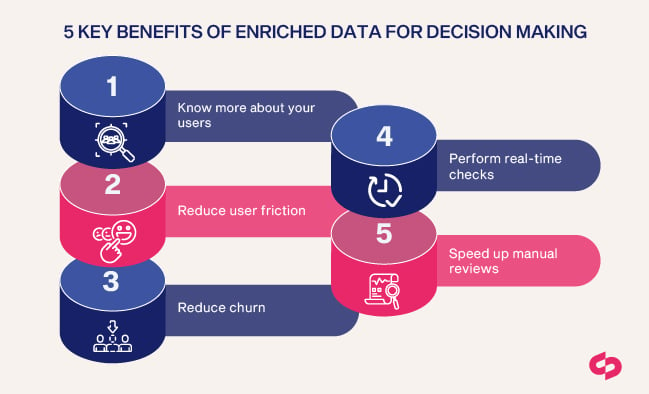
- Better segmentation and personalization: complete profiles make it possible to target by industry, size, location or behavior instead of guessing.
- Faster, more confident decisions: decision-makers work with current external context, not last quarter’s snapshot.
- New revenue opportunities: enriched data shows underserved segments, pricing gaps and accounts ready to buy.
- Lower risk and fraud: cross-checking internal records against independent external sources exposes inconsistencies early.
- Higher ROI on existing data: the CRM, catalog and data warehouse you already pay for become more valuable once their gaps are filled.
Best Practices for Data Enrichment
- Tie every attribute to a use case. Enriching “everything” inflates costs and storage without improving decisions.
- Clean before you enrich. Matching works poorly on duplicated or badly formatted records. Our data cleaning services handle both steps in one workflow.
- Track provenance and freshness. Store the source and the collection date for every enriched field, so analysts know how much to trust it.
- Use confidence scores for matches. Send low-confidence matches to review instead of writing them straight into production systems.
- Stay compliant. Collect only publicly available data, respect privacy regulations such as GDPR and CCPA, and avoid enriching individual profiles with personal data without a lawful basis. Read our overview of web scraping legality, compliance and privacy.
- Automate the refresh cycle. Manual enrichment does not scale and decays quickly. Scheduled, monitored pipelines keep data reliable.
Build or Buy Your Enrichment Pipeline?
Building in-house gives you full control, but it takes engineering time for scrapers, proxies, anti-bot handling, matching logic and maintenance every time a source changes. A managed provider delivers enriched, validated datasets on a schedule so your team can focus on analysis. Compare both options in managed scraping vs DIY and check typical budgets in how much web scraping costs.
Frequently Asked Questions
What is the difference between data enrichment and data cleaning?
Data cleaning corrects and standardizes the data you already have (removing duplicates, fixing formats, resolving inconsistencies). Data enrichment adds new attributes from external sources. Most pipelines clean first and enrich afterwards.
Is web scraping a legitimate source for data enrichment?
Yes, when it is limited to publicly available data, respects each site’s terms and technical limits, and complies with privacy laws such as GDPR and CCPA. Personal data needs a lawful basis to be processed.
How often should enriched data be refreshed?
It depends on how fast the attribute changes. Prices and stock may need daily or intraday updates, job postings and news weekly, and firmographic attributes monthly or quarterly.
What are the most common types of data enrichment?
Firmographic, demographic, technographic, contextual, behavioral and product/pricing enrichment. B2B companies focus on firmographic and technographic data, while retailers get the most value from pricing and product enrichment.
Conclusion
Data enrichment turns incomplete internal records into a complete, current view of customers, competitors and markets, and that view is what better business decisions are built on. Because the web is the largest and most up-to-date source of external data, web scraping has become the most flexible way to enrich data at scale, provided it comes with solid entity matching, validation and compliance.
Need enriched, decision-ready data? Scraping Pros designs and runs managed pipelines for extraction, cleaning, enrichment and validation tailored to your use case. Talk to our team to scope your project.
