
Most data teams build their scraping infrastructure the same way they think about their markets: one industry at a time. A retail team has its pipeline, the logistics team has another, and the finance unit maintains a third. Each works. Each delivers something. But here’s what gets lost in that arrangement: the signals that only become visible when you look across all three at once.
Consider a mid-sized consumer goods company tracking competitor prices in e-commerce while separately monitoring supply chain disruptions in logistics reports. Neither dataset, on its own, predicted the inventory crisis that hit their category in Q3. But together, they would have. The early warning was there, sitting unread in the gap between two siloed pipelines.
Cross-industry AI scraping addresses exactly that gap. It is not a different way to collect data. It is a fundamentally different way to understand what data is telling you.
1. The Vertical Data Isolation Trap
The decision to build vertical-specific scrapers makes operational sense in the short term. Teams want data fast, schemas are easier to define when the domain is narrow, and vendors often specialize by industry. Over time, though, these choices create what we call the vertical data isolation trap: an architecture where each pipeline is optimized for a single domain but blind to the correlations that cross domain boundaries.
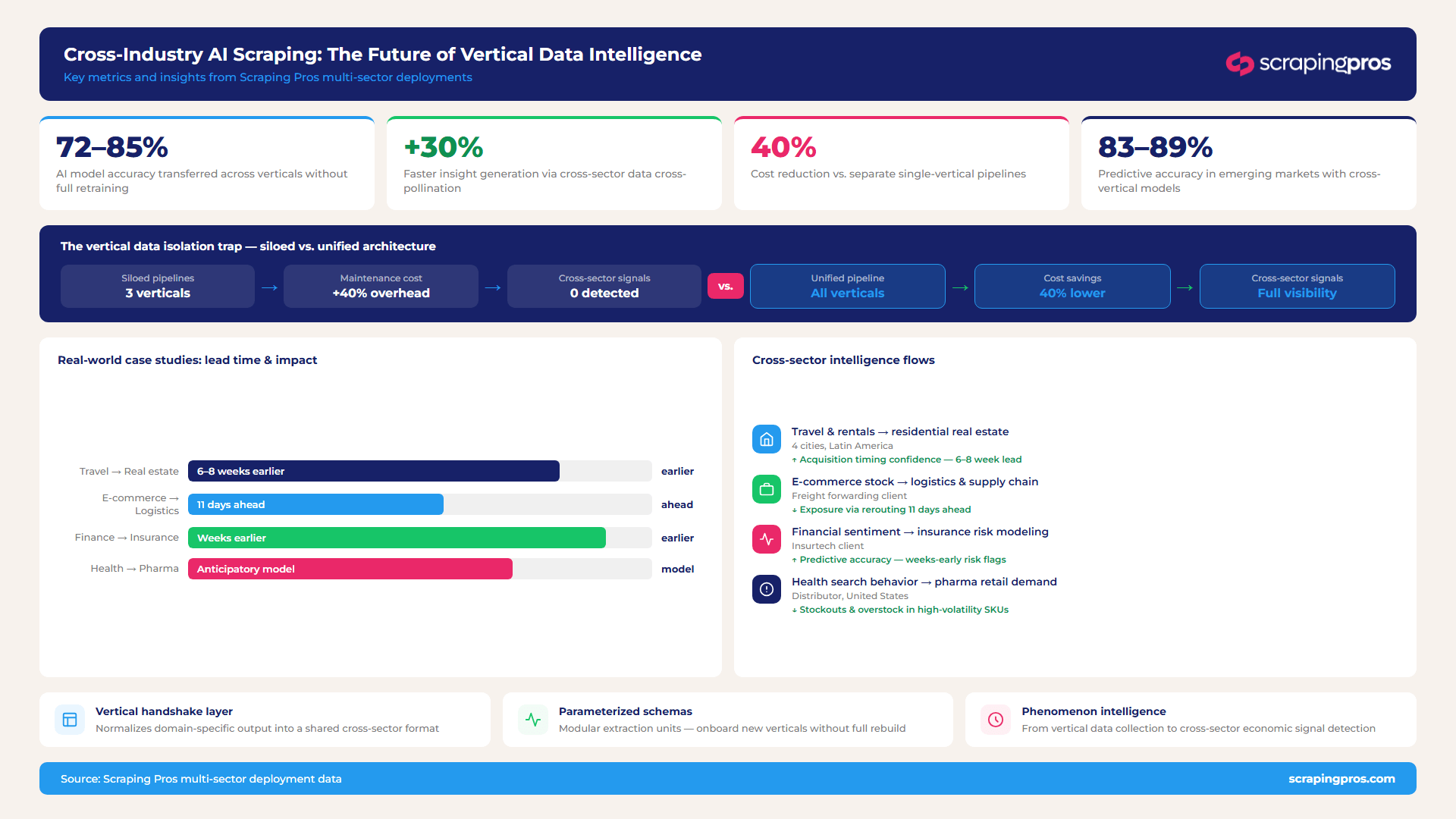
The cost is not just technical. , and running separate pipelines for each vertical carries a 40% overhead premium compared to unified cross-industry architectures, once you account for maintenance, infrastructure, and the duplicated effort of normalizing similar data types across different schemas. But the more significant cost is the intelligence that never gets generated.
Macro phenomena — inflation, consumer sentiment shifts, supply disruptions, regulatory changes — do not respect industry boundaries. A architecture that does will always be one step behind the market forces that actually drive decisions.
2. AI Model Transferability Across Verticals
One of the most counterintuitive findings in applied machine learning is that a model trained to detect price volatility patterns in airline ticketing can, with relatively minor adaptation, identify analogous patterns in pharmaceutical wholesaling. The features are different. The domain language is different. But the underlying structure — how prices respond to demand signals, seasonal triggers, and competitive pressure — is structurally similar enough that the model transfers.
shows that cross-domain AI models achieve accuracy rates ranging from 72 to 85% in a target domain without full retraining — and can reduce model development time by up to 40%. Across Scraping Pros’ multi-sector deployment experience, those figures hold: AI models adapted for cross-vertical applications achieve 72 to 85% accuracy in the target domain. That range depends on the structural similarity between source and target verticals and the quality of the normalization layer. But even at the lower bound, it represents a meaningful reduction in the time and cost of standing up intelligence in a new market.
The mechanism is called feature-level transferability. Rather than retraining a model on a new domain from scratch, the system reuses learned representations of structural patterns while adapting only the domain-specific vocabulary layer. What this makes possible in , in practice:
- Insight generation 30% faster than equivalent single-domain architectures, because anomalies detected in one sector immediately trigger investigative queries across adjacent ones.
- 40% cost reduction in infrastructure and maintenance versus running isolated pipelines per vertical.
- 83 to 89% predictive accuracy on forward-looking market indicators in emerging markets, where cross-vertical signals carry disproportionate information value.
- Faster vertical onboarding: a new industry domain can be integrated into an existing cross-vertical architecture without rebuilding the pipeline from scratch.
3. Cross-Sector Innovation Patterns
The value of cross-industry data intelligence is easiest to see in specific pairs of verticals where data flows in a directionally meaningful way. What follows are four patterns drawn from real Scraping Pros deployment contexts, each illustrating a different mechanism of cross-sector signal transfer.
3.1 Travel and Short-Term Rentals → Residential Real Estate
Search and pricing behavior on short-term rental platforms is a leading indicator of residential market movement in urban areas. When demand for furnished short-term rentals in a specific neighborhood spikes and supply tightens, the pattern typically precedes equivalent movement in long-term rental prices by six to eight weeks. The mechanism is investor behavior: landlords observe occupancy rates and yields in the short-term market before adjusting their long-term inventory strategy.
Scraping Pros deployed this framework for a real estate investment firm operating across four cities in Latin America. By integrating our coverage into the same pipeline tracking data, the model identified neighborhood-level pricing inflection points significantly ahead of any single-source approach.
| Lead time advantage | 6 to 8 weeks earlier signal vs. residential-only monitoring |
| Coverage | 4 cities, unified cross-vertical pipeline |
| Business impact | Acquisition decisions timed with measurably higher confidence; reduced exposure to late-entry pricing |
3.2 E-commerce Stock Data → Logistics and Supply Chain
Out-of-stock patterns and delivery time estimates on retail platforms contain operational intelligence that logistics companies rarely access directly. When a category of products shows extended delivery windows and fragmented availability across multiple retailers simultaneously, the underlying cause is almost always a supply chain disruption still weeks away from appearing in official trade reports.
A freight forwarding client engaged Scraping Pros to build a cross-vertical monitoring system scraping SKU-level availability and delivery estimates across major e-commerce platforms in parallel with port congestion data and carrier capacity indicators. Our formed the backbone of the e-commerce layer in this architecture.
| Detection lead time | 11 days before the disruption surfaced in logistics industry publications |
| Vertical combination | E-commerce availability data + port congestion + carrier capacity |
| Business impact | Early rerouting decisions that reduced financial exposure substantially; shift from reactive to anticipatory operations |
3.3 Financial Forums and Sentiment Data → Insurance Risk Modeling
Actuarial models are built on historical claims data, which by definition lags the behaviors they are trying to model. Scraping financial forums, consumer complaint boards, and product review platforms for sentiment around specific financial products produces a behavioral signal with different temporal properties: it reflects current anxiety and dissatisfaction before that dissatisfaction materializes in claims.
Scraping Pros built a cross-vertical pipeline for an insurtech client using our infrastructure that normalized sentiment data from financial discussion platforms against product category and demographic proxies, then fed those signals into the client’s risk models.
| Predictive accuracy | Measurably improved for emerging claim clusters vs. historical-only models |
| Signal type | Behavioral and sentiment data upstream of claims activity |
| Business impact | Risk concentrations flagged weeks earlier; improved pricing precision on high-volatility product lines |
3.4 Consumer Health Search Behavior → Pharmaceutical Retail Demand
Search query patterns around symptoms, home remedies, and over-the-counter products are a proxy for pharmaceutical demand that operates upstream of purchase behavior. confirms that Google search trends show moderate to strong correlations with real-world health demand — and can forecast demand peaks weeks before they materialize. When those patterns shift by geography or symptom cluster, retail demand follows within a predictable window.
For a pharmaceutical distributor managing inventory across regional markets in the United States, Scraping Pros integrated consumer search trend data with pharmacy platform scraping to build a demand forecasting model at the intersection of public health behavior and retail supply. Operating across geographically dispersed markets with significant regional variation in consumption patterns — from the Sun Belt to the Northeast — the cross-industry architecture allowed the distributor to position inventory in anticipation of regional demand shifts rather than in reaction to them, reducing both stockouts and overstock situations in high-volatility SKU categories.
| Market coverage | Multiple regional markets across the United States |
| Model type | Cross-vertical demand forecasting combining health search trends and retail availability data |
| Business impact | Reduced stockouts and overstock situations in high-volatility SKU categories; inventory positioned ahead of regional demand shifts rather than in reaction to them |
4. Multi-Industry Deployment Strategies
Building a cross-industry scraping architecture is not simply a matter of connecting existing vertical pipelines. The infrastructure requires deliberate design choices at several layers.
The most critical is what we refer to as the vertical handshake layer: the normalization and semantic translation component that converts domain-specific output into a shared representational format that adjacent models can interpret. Without this layer, combining data from retail pricing and logistics capacity produces a schema collision, not intelligence.
Schema flexibility matters from day one. Pipelines designed for cross-vertical deployment use parameterized schemas and modular extraction units rather than hardcoded domain assumptions. This is the architectural difference between a scraper built for a single client in a single industry and a cross-industry intelligence system that can onboard a new vertical without a full rebuild. For teams evaluating whether to build or outsource this layer, our breakdown of covers the key decision criteria.
Emerging markets present a particular opportunity in this context. The relative scarcity of consolidated public data sources across Latin America, Southeast Asia, and Sub-Saharan Africa means that cross-industry signals carry more information value than in mature markets where data is abundant and already priced in. The less structured the existing data environment, the more leverage a well-designed cross-industry pipeline provides.
5. The Next 24 Months: From Vertical Scraping to Phenomenon Intelligence
The most significant shift in enterprise data strategy over the next two years will not be about scraping speed, volume, or AI sophistication in isolation. It will be about the unit of analysis. Right now, most organizations think about scraped data in terms of industries: retail data, financial data, logistics data. The next stage thinks in terms of economic phenomena: inflation dynamics, consumer confidence trajectories, supply concentration risk, regulatory pressure cycles.
Phenomena do not belong to industries. Inflation shows up in retail prices, in financial instrument behavior, in real estate listings, in job posting salary bands, and in raw material quotes simultaneously. An organization that treats each of those signals as a separate vertical dataset will always be assembling a picture from fragments. An organization with a cross-industry intelligence architecture is watching the same phenomenon from six angles at once.
Scraping Pros is already building in this direction. The clients who have moved to cross-vertical pipelines are not asking how to scrape more. They are asking what their combined datasets can tell them that no single source can. For a broader view of how this plays out across sectors, see our analysis of . That question, more than any individual data source or AI model, defines what data strategy looks like in the next cycle.
The vertical is where data lives. The phenomenon is where the value is. The distance between them is where cross-industry AI scraping operates.
Frequently Asked Questions
What is cross-industry AI scraping?
A single AI-driven pipeline that collects and connects data across multiple industries simultaneously, surfacing patterns that siloed architectures cannot detect.
How accurate are AI models when transferred across different industries?
72 to 85% accuracy in a new vertical without full retraining — enough to generate actionable intelligence from day one while the model continues to improve.
What industries benefit most from cross-vertical data intelligence?
Industry pairs with strong temporal relationships deliver the highest ROI: travel and real estate, e-commerce and logistics, financial services and insurance, health behavior and pharmaceutical retail.
How does multi-industry deployment reduce scraping infrastructure costs?
A unified cross-industry architecture costs approximately 40% less than equivalent single-vertical pipelines, through shared infrastructure and reusable normalization components.
What is the vertical data isolation trap?
The accumulated cost of building scraping infrastructure one industry at a time — each pipeline works in isolation and misses the cross-sector signals that drive real market movements.
Ready to turn your vertical data silos into cross-industry intelligence?
At Scraping Pros, we architect AI-driven scraping pipelines that extract and connect intelligence across sectors. Whether you operate in a single industry or span multiple markets, our cross-vertical frameworks are built to surface the patterns that matter most. to start a conversation.
Need reliable data at enterprise scale?
At Scraping Pros we build custom web scraping solutions for enterprise teams. Tell us about your data challenge.
