
The web was built for humans. Dynamic JavaScript rendering, adaptive layouts, session-based content gating, — every layer of modern web architecture creates friction for automated data collection. Maintenance cycles on rule-based scrapers have grown shorter. Teams that once managed a portfolio of scrapers with a quarterly review now patch them weekly.
The pattern is structural, not incidental. Websites iterate faster than scraper maintenance cycles allow. The gap between what a site serves and what a static selector can reliably extract has become a fundamental operational problem — one that autonomous scraping agents powered by GPT-4 integration and multimodal AI are now capable of addressing at scale.
This article covers how autonomous scraping agents work, the architecture decisions that make them viable in production, where multimodal extraction changes the calculus for specific verticals, and what real-world deployments look like — including use cases emerging from Latin American markets.
1. The Autonomous Scraping Revolution: GPT-4 and Multimodal AI
An autonomous scraping agent is a system that perceives a web environment, reasons about its structure, plans and executes extraction actions, and adapts its behavior based on observed outcomes — without requiring a human to rewrite its rules when the environment changes.
That definition separates autonomous scraping agents from AI-assisted scraping, where a model might help generate selectors or classify output, but a human still defines the extraction logic. In a fully autonomous agent, the model is the extraction logic.
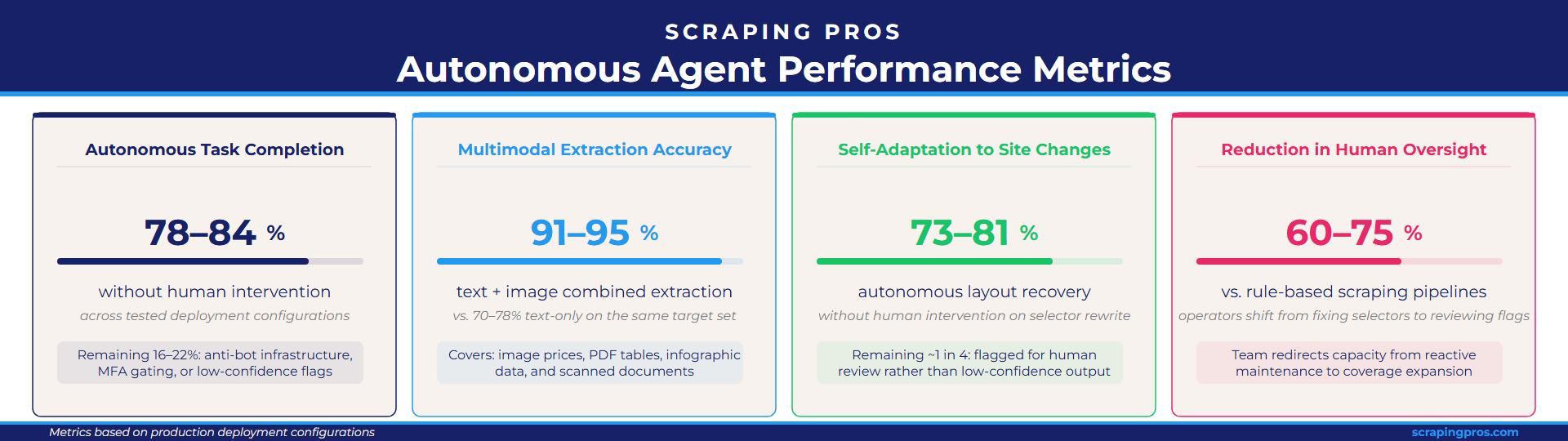
achieves task completion without human intervention in 78–84% of scenarios across tested deployment configurations. That figure carries weight when you consider what “task completion” involves: navigating pagination, handling modal overlays, maintaining session state, resolving ambiguous DOM structures, and validating extracted output against an expected schema.
2. GPT-4 Integration Architecture
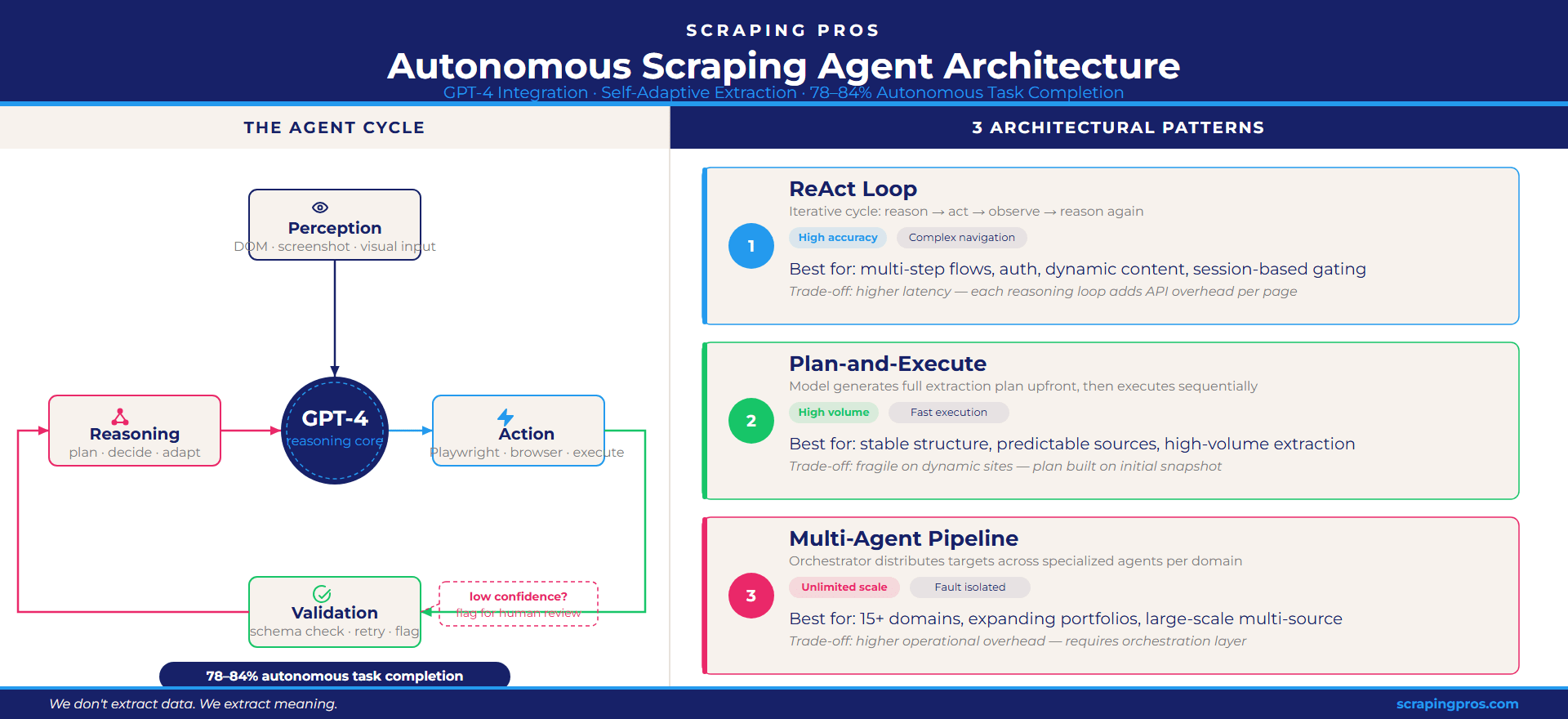
The architecture of production-grade autonomous scraping agents runs across four interdependent layers.
Perception layer. The agent receives a structured representation of the page — the rendered DOM, a screenshot, or both. For sites where content lives primarily in HTML, the DOM provides sufficient signal. For sites where layout, imagery, or visual context carry meaning, the screenshot becomes the primary input. The perception layer’s job is to convert the web page into a format the model can reason about efficiently.
Reasoning layer. GPT-4 processes the perceived input and generates a plan: which elements to target, whether the page requires interaction before extraction (clicks, scrolls, form submissions), how to handle conditional structures, and whether the current state matches the expected schema. This is where the model’s general-purpose language and reasoning capabilities translate into scraping-specific decisions.
Action layer. The plan becomes execution. A browser automation framework — , Puppeteer, or equivalent — carries out the model’s instructions: targeting selectors, triggering interactions, waiting for dynamic content to resolve, and capturing output. The action layer is the bridge between model cognition and browser state.
Validation layer. Extracted output is compared against the target schema. If the result falls outside acceptable parameters — a field is missing, a value is in the wrong format, confidence is below threshold — the agent re-enters the reasoning loop with the discrepancy as new context. This self-correction mechanism is what separates autonomous scraping agents from models that generate selectors once and stop.
The loop between reasoning and validation is where the 78–84% autonomous task completion rate is earned. The remaining 16–22% typically involves sites with aggressive , login-gated content with multi-factor authentication, or schema changes significant enough that the agent’s uncertainty score triggers a human review flag rather than an autonomous retry.
3. Multimodal AI: Text + Vision Extraction
Most scraping infrastructure treats visual content as an obstacle — something to route around, not through. A product image, a price displayed as a banner graphic, a table embedded in a PDF, a chart with data that has no accessible tooltip — all of these represent extraction dead ends for systems that parse only the DOM. Autonomous scraping agents with multimodal capabilities change that constraint entirely.
The performance implications are measurable. Combined text and image extraction accuracy in production deployments runs between 91–95%, compared to 70–78% for text-only approaches on the same target set. The delta is most pronounced on sites that deliberately render data visually — a pattern common in markets where web development practices differ from the Western defaults that most scraping tools were designed around.
Practically, this matters in four distinct scenarios.
Visual price rendering. Marketplaces in Southeast Asia and Latin America frequently display prices as dynamically generated images rather than text nodes. Anti-scraping by design, in some cases. GPT-4 Vision reads these directly.
Embedded PDFs and documents. B2B portals, government procurement sites, and financial data providers often publish structured data inside embedded PDFs. Multimodal extraction pulls from these without requiring a separate PDF parsing pipeline.
Infographic data. Market research pages, dashboard exports, and analytics summaries frequently contain data embedded in charts and graphs. Where no machine-readable version exists, vision extraction is the only viable path.
Scanned content in hybrid pages. In markets with legacy infrastructure, scanned documents are often embedded alongside standard HTML. A multimodal agent handles both in the same pass.
The architectural implication is that the perception layer must be designed to decide — based on page analysis — when to route through the vision model versus the DOM parser. That routing decision itself can be made by the model, reducing the need for manual configuration per target site.
4. Self-Adaptive Autonomous Scraping Agents
Rule-based scrapers have a predictable failure mode: a site updates its structure, the selector breaks, data stops flowing, and the problem surfaces only when a downstream system notices missing records. The time between the site change and the human fix is dead time in the data pipeline.
Autonomous scraping agents handle structural changes differently. When a trained selector fails, the agent doesn’t fail silently — it observes the failure, examines the current page state, generates a new extraction approach, validates the output, and continues. Across tested deployment scenarios, autonomous adaptation to site changes succeeds in 73–81% of cases without human input.
The remaining cases — roughly one in four — involve changes significant enough that the agent’s confidence drops below an acceptable threshold. At that point, the system flags the target for human review rather than producing low-confidence output. This is the correct behavior. An agent that always produces something, even when uncertain, creates downstream data quality problems that are harder to catch than an explicit failure flag.
Human oversight in well-designed autonomous scraping agents runs 60–75% lower than in rule-based equivalents. The reduction comes not from removing human judgment, but from changing what humans are asked to judge. Operators shift from fixing broken selectors to reviewing flagged edge cases and approving new target schemas. The work changes from reactive maintenance to exception handling.
This shift has compounding operational value. Teams that previously needed a developer on standby for scraper maintenance can redirect that capacity toward expanding coverage or improving data quality downstream.
5. LATAM in Focus: When the Web Doesn’t Fit the Default Model
Latin American markets present extraction challenges that make autonomous scraping agents particularly relevant across four sectors.
Retail and e-commerce intelligence. The retail web across Brazil, Mexico, Argentina, and Colombia is deeply fragmented — national marketplace operators, department store chains, and vertical retailers each run separate infrastructures with different update cadences. Mobile-first design is the norm, and price and product metadata are frequently rendered visually rather than as text nodes. In deployments covering 40 or more LATAM retail domains, teams report 65–70% reduction in maintenance overhead compared to rule-based systems.
Government and regulatory intelligence. Public procurement portals, regulatory filing systems, and statistical agencies across the region publish data in formats that resist standard extraction: scanned PDFs, non-standard HTML encoding, and image-rendered tables. Compliance firms and market research providers working across LATAM jurisdictions routinely require a multimodal pipeline — DOM parsing alone is insufficient for a significant share of public-sector sources.
Financial services and commodity markets. Regional banks, fintechs, and credit bureaus publish rate information and product comparisons in visual formats that previously required manual transcription. In agricultural markets — where South America’s role as a global exporter in grains, oilseeds, and livestock drives demand for price discovery — data is scattered across cooperative platforms, exchange dashboards, and government agencies with minimal API infrastructure and irregular update schedules. Our infrastructure is specifically designed for these environments.
The common thread is variability. LATAM’s web infrastructure is diverse enough that rigid extraction templates fail faster than in more homogeneous markets, making autonomous scraping agents an operational requirement rather than an optimization.
6. Production Realities: What the Architecture Guides Don’t Cover
Deploying autonomous scraping agents at production scale involves a set of operational considerations that get less coverage than the model architecture itself.
A) Token economics. A poorly designed agent loop can make 10–20 GPT-4 API calls per page. At volume, that’s not economically viable. Production architectures use GPT-4 for complex reasoning tasks — structural analysis, multimodal extraction, edge case resolution — and route simpler decisions to lighter models or deterministic logic. The routing layer is as important as the reasoning layer for cost management.
B) Calibrated uncertainty. The most operationally significant design decision in autonomous scraping agents is how they handle low-confidence states. An agent that always produces output is dangerous in data pipelines where downstream systems trust extraction results. Production systems define explicit confidence thresholds: above the threshold, the agent proceeds autonomously; below it, the output is flagged and held for human review. The threshold should be tunable per use case — a price monitoring application tolerates different error rates than a legal document extraction pipeline.
C) Observability. Every reasoning decision the agent makes should be logged in a structured format — what it perceived, what it decided, what it executed, and what the outcome was. Without this, debugging production failures is practically impossible. When an agent extracts an incorrect value or misses a field, the log should make the reasoning path traceable. This is a design requirement, not a nice-to-have.
D) Rate behavior modeling. Autonomous scraping agents should model the behavioral signature they present to target sites — request timing, user agent patterns, interaction sequences. Fixed delays are insufficient. Production systems vary request timing based on observed site behavior and adjust dynamically when signals suggest rate limiting is being applied.
E) Schema versioning. Target sites evolve. The schemas that define expected extraction output need version control and a review process for updates. An autonomous agent can detect when its output no longer matches an existing schema — but the decision to update the schema is a human judgment call that belongs in a documented process.
7. Three Architectural Patterns for Production Deployment
Different extraction workloads call for different autonomous scraping agent architectures. Three patterns cover most production scenarios.
1. ReAct loop (Reasoning and Acting). The agent reasons about what to do, takes an action, observes the result, and reasons again based on the new state. This iterative approach handles sites with complex navigation requirements — multi-step forms, authentication flows, content that loads conditionally based on previous interactions. The cost is latency: each reasoning-action-observation cycle adds time. ReAct loops are appropriate for high-value, lower-volume targets where accuracy matters more than throughput.
2. Plan-and-execute. The model generates a complete extraction plan before any browser interaction begins, then executes the plan sequentially. On sites with predictable, stable structure, this approach uses fewer tokens and runs faster than iterative reasoning. The tradeoff is fragility on dynamic sites — a plan built on an initial page snapshot may fail if the page state changes during execution.
3. Multi-agent pipeline. An orchestrator distributes extraction targets across specialized autonomous scraping agents — one per site type, one for validation, one for data enrichment and normalization. Each agent operates independently; the orchestrator manages routing, retries, and output aggregation. This pattern scales horizontally and isolates failures: a problematic target affects only the agent handling it, not the broader pipeline. The operational overhead is higher, but for large-scale, multi-domain extraction workloads, it’s the architecture that holds up.
Choosing between these patterns depends on target complexity, volume requirements, and acceptable latency. Most production deployments at scale use a combination — multi-agent orchestration with ReAct loops for complex individual targets and plan-and-execute for high-volume, structurally stable sources.
8. When Autonomous Scraping Agents Make Sense (and When They Don’t)
The decision to deploy autonomous scraping agents rather than maintain rule-based scrapers depends on a concrete evaluation of the extraction workload.
Autonomous scraping agents justify the investment when the target portfolio spans more than 15–20 distinct domains with independent update cycles, when site structure changes frequently enough that maintenance is consuming more than 20% of engineering time, when the data includes visual content that DOM parsing can’t reliably capture, or when the extraction scope is expanding faster than a team can build and maintain custom scrapers.
Rule-based scrapers remain appropriate when the target set is small and stable, when the extracted data is entirely text-based and consistently structured, when latency requirements are strict enough that the reasoning overhead of an agent loop is unacceptable, or when the technical infrastructure for agent deployment and observability isn’t in place.
The right architecture matches the extraction workload. Autonomous scraping agents are not universally superior — they carry real costs in latency, token spend, and operational complexity. What they provide is adaptability at a scale that rule-based systems can’t match.
9. Deploy Autonomous Scraping Agents at Scale with Scraping Pros
Scraping Pros builds and operates autonomous scraping agents for organizations with demanding data requirements — across , financial services, regulatory intelligence, and , globally.
Our agent architecture integrates GPT-4 and multimodal AI into production extraction pipelines designed for reliability, observability, and scale. If your data collection is constrained by maintenance overhead, visual content, or the pace at which your target sites change, our team can assess your current setup and identify where autonomous scraping agents deliver the most measurable impact.
We operate across North America, Europe, and Latin America, with hands-on experience in the extraction challenges specific to each market.
Get in touch with the Scraping Pros team to discuss your extraction requirements — or to request a technical review of your current scraping infrastructure.
Scraping Pros provides enterprise web scraping and data extraction services globally. This article reflects implementation experience across production deployments in multiple industries and geographies.
Frequently Asked Questions
1. What is an autonomous scraping agent?
A system that perceives a web page, reasons about its structure using a large language model, executes extraction actions through a browser automation framework, and self-corrects when output doesn’t match the expected schema — without requiring human intervention to update its logic when sites change.
2. How does GPT-4 integration improve autonomous scraping agents’ accuracy?
GPT-4 replaces static selectors with dynamic reasoning. Rather than matching a hardcoded CSS path, the model analyzes the current page state and decides how to extract the target data — adapting to structural changes, handling conditional layouts, and validating output against a schema in the same loop.
3. What types of content can multimodal AI extract that standard scrapers cannot?
Prices and data rendered as images, tables embedded in PDFs, charts without accessible tooltips, and scanned documents hosted on web portals. Any content where the meaningful data exists visually rather than as text in the DOM falls into this category.
4. When do autonomous scraping agents make more sense than rule-based scraping?
When the target portfolio covers many domains with independent update cycles, when site structure changes frequently enough to create significant maintenance overhead, or when the data includes visual content that DOM parsing can’t reliably capture.
5. Is autonomous scraping legal?
Legality depends on the target site’s terms of service, the type of data being collected, how it’s used, and the jurisdiction involved. Publicly available data that doesn’t involve personal information or circumvent access controls is generally permissible in most jurisdictions, but each use case warrants its own legal review. Our covers this in detail.
Need reliable data at enterprise scale?
At Scraping Pros we build custom web scraping solutions for enterprise teams. Tell us about your data challenge.
