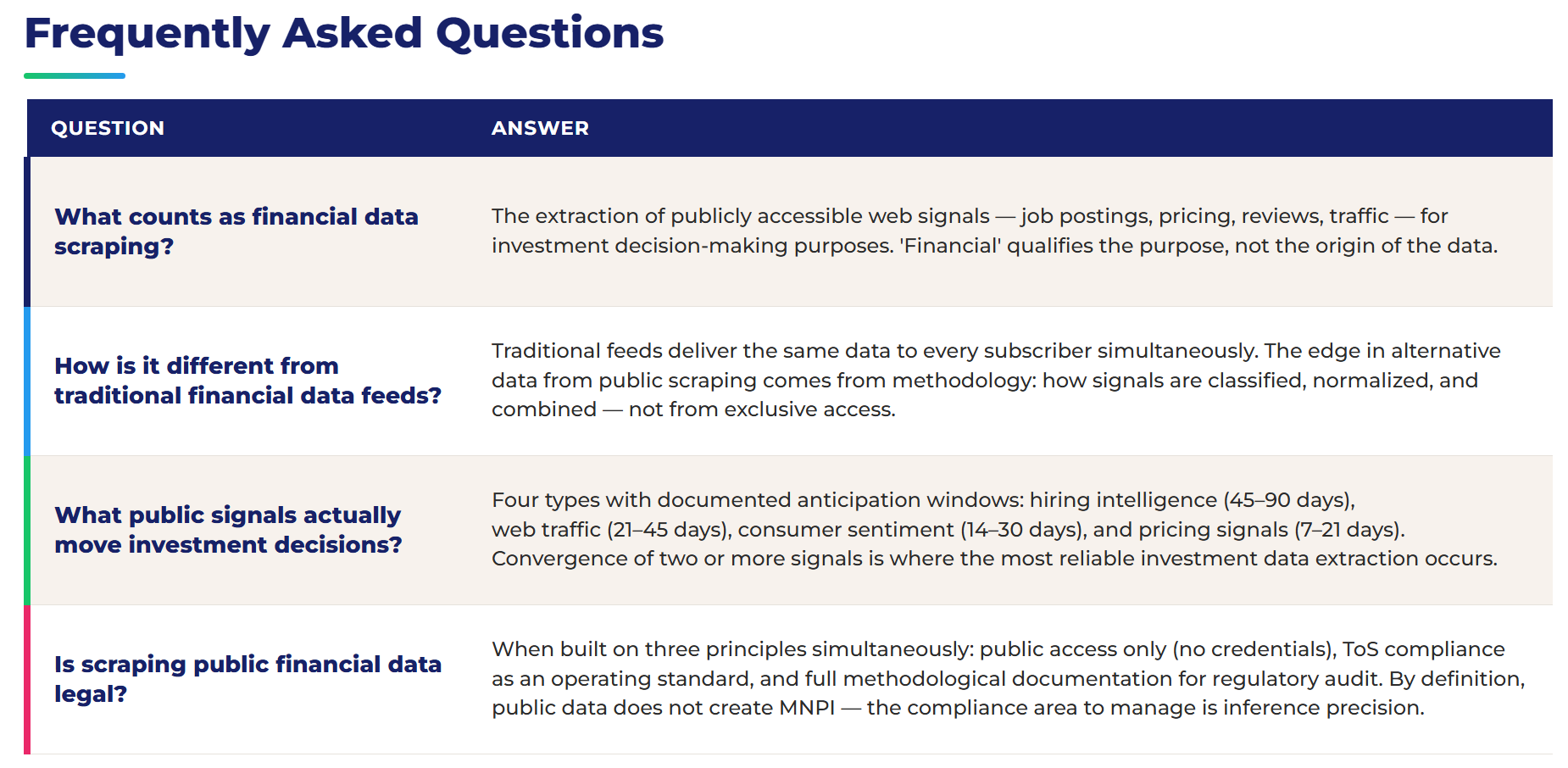
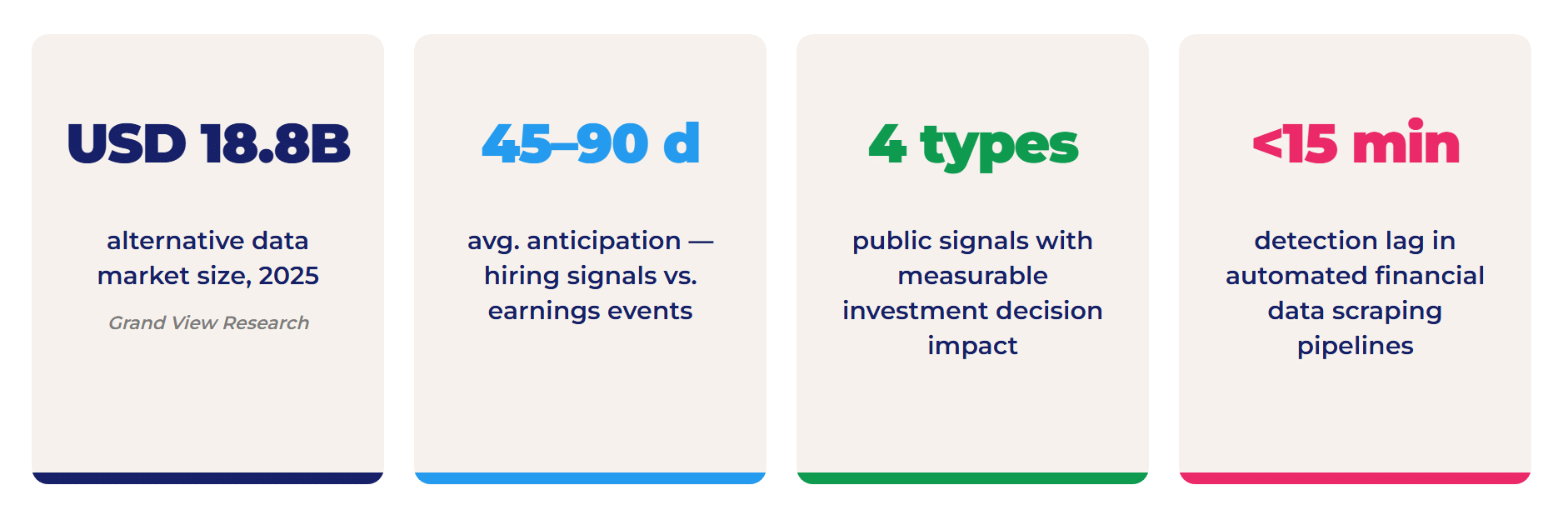
extracts public web signals — job postings, pricing changes, consumer reviews, web traffic — and converts them into alternative data that feeds investment decisions weeks or months before equivalent information appears in any official report. The , according to Grand View Research. The firms not using it are not in a neutral position.
1. What Counts as Financial Data Scraping?
Financial data scraping is the systematic, automated extraction of publicly available web signals for the purpose of informing investment decisions, asset valuation, or risk management. The word ‘financial’ does not qualify the origin of the data — it qualifies the purpose of the analysis. A product review on a marketplace is consumer feedback; aggregated at scale to estimate revenue penetration before a company reports earnings, it becomes investment data extraction.
Three characteristics distinguish financial data scraping from generic extraction:
- Latency is a value variable: in investment contexts, data that arrives first is worth exponentially more than data that arrives later. Financial data scraping calibrates extraction frequency to the rate of change of each signal source — not to pipeline capacity.
- Cross-source normalization is a prerequisite: a financially useful signal rarely comes from a single source. Web traffic, app store rankings, and advertising spend have to be normalized across sources before they produce a reliable signal. The is where investment-grade alternative data is made or destroyed.
- Compliance is architecture, not a checklist: institutional investors operate under regulatory frameworks that determine what data they can use and how. A financial data scraping pipeline designed for institutional use is built compliance-first: only publicly accessible data, no credentials, documented sources and methods, full audit trail.
Financial data scraping covers: job postings, e-commerce and marketplace pricing, product and service reviews and ratings, web traffic and app store rankings, public regulatory filings and announcements, social media and investor forum mentions, and publicly aggregated location data. It does not cover data behind paywalls, data obtained with credentials, or anything requiring a terms of service violation.
2. How Is It Different From Traditional Financial Data Feeds?
The structural difference between traditional financial data and public signals sourced through investment data extraction is not speed alone — it is the asymmetry of interpretation. A Bloomberg terminal delivers the same earnings release to every subscriber simultaneously. The edge in alternative data is not access — it is methodology. Two firms monitoring the same set of job postings for a company can reach radically different conclusions depending on how they classify roles, at what frequency they update, and against what historical baseline they compare. That interpretive gap is where alpha is built — the same logic behind any .
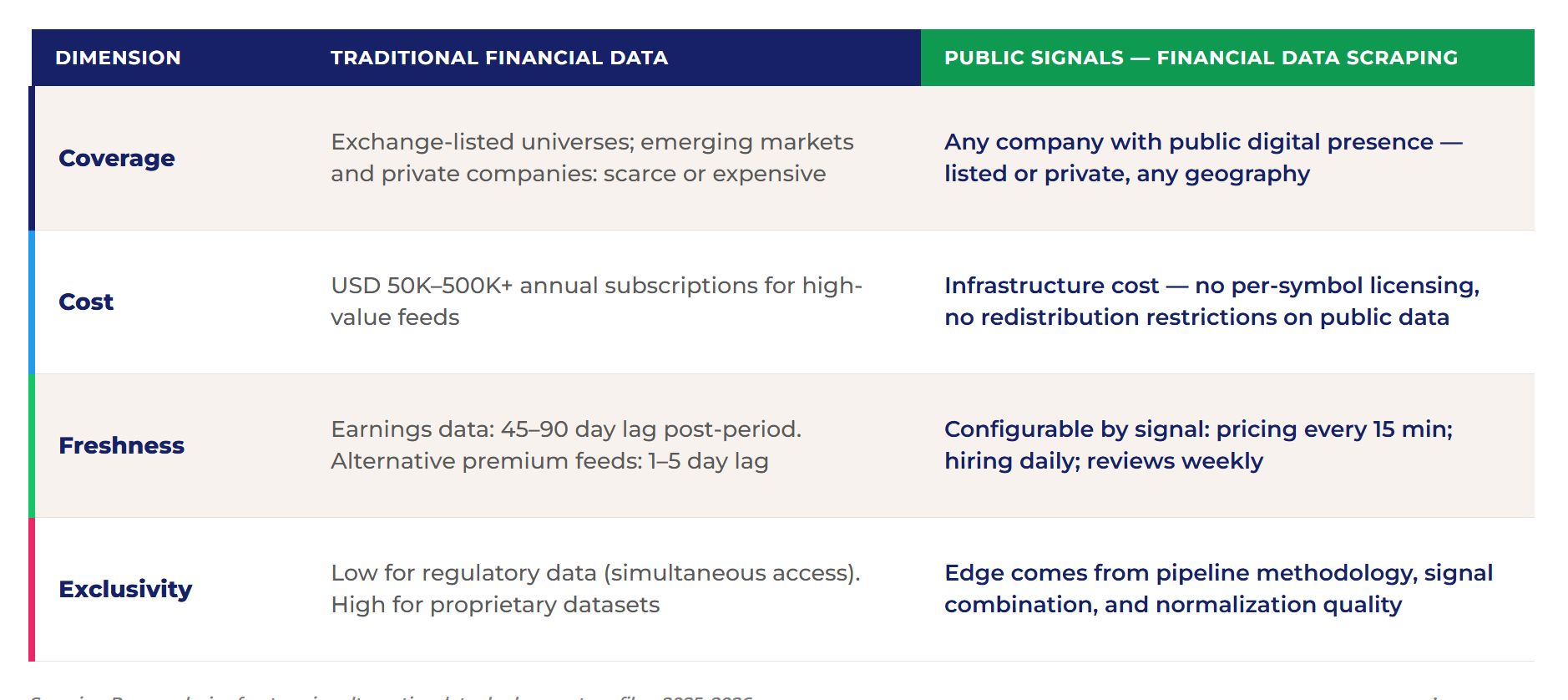
Scraping Pros analysis of enterprise alternative data deployment profiles, 2025–2026.
The latency argument is the one that matters most for investment decision-making: a balance sheet that reveals margin compression arrives 45 days after that compression already occurred. Public signals captured through financial data scraping detect the indicators that precede that compression — hiring changes, pricing shifts, sentiment deterioration — with weeks of anticipation. That anticipation window is measurable, and its value is documented in the Signal Latency Score introduced in the next section.
3. The Four Signals That Actually Move Investment Decisions
The Signal Latency Score (SLS) measures the average anticipation of each signal type relative to the financial event it predicts — an earnings revision, a guidance change, a restructuring announcement. It is expressed in days and derived from Scraping Pros’ retrospective analysis of signal-to-event correlation across 200+ monitored companies, 2024–2026. The higher the SLS, the earlier the signal is actionable relative to when the market has official information.
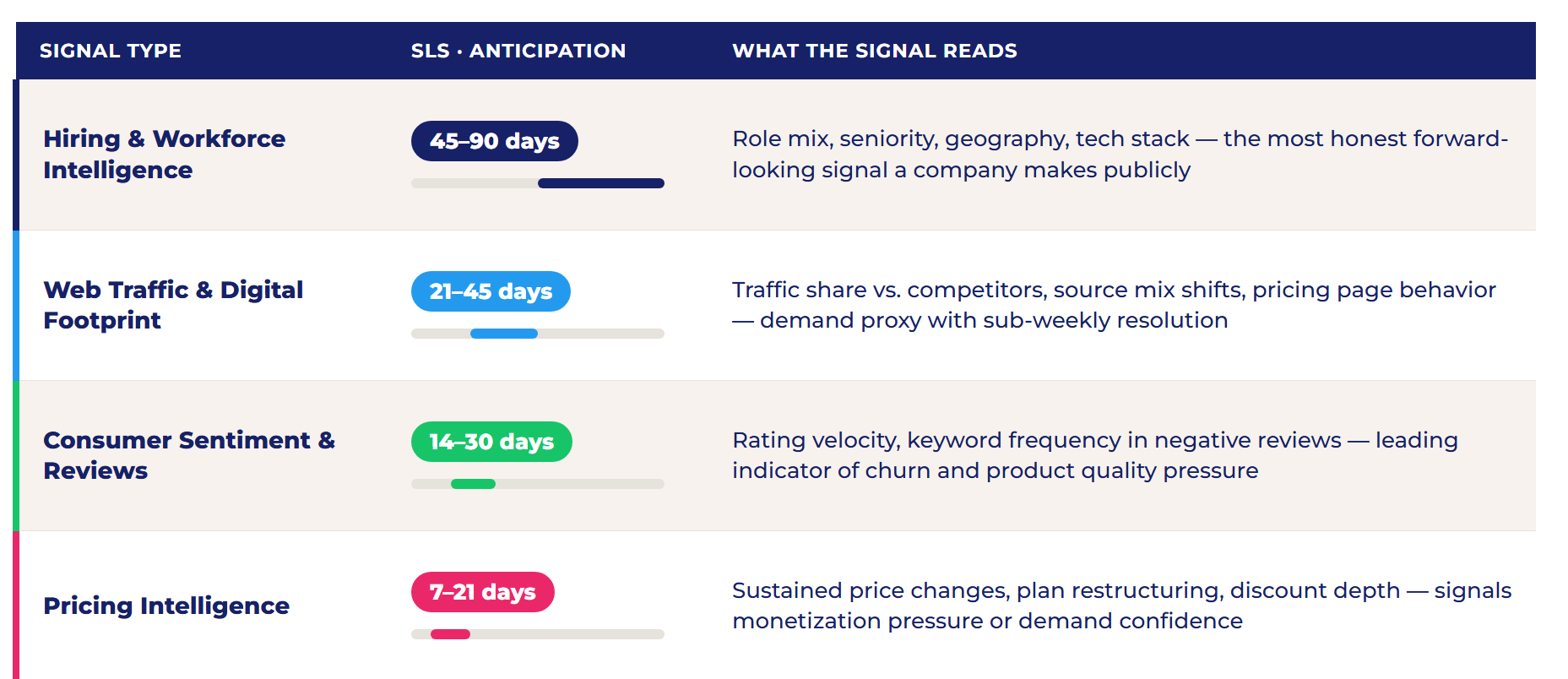
Source: Scraping Pros signal-to-event correlation analysis, 200+ monitored companies, 2024–2026.
How signals combine — the convergence argument
No single signal type produces a reliable investment thesis in isolation. The measurable return comes from convergence: when two or more signals from different categories point in the same direction simultaneously — the same principle behind , where signals only become visible when you read across sources.
A company showing hiring contraction in sales roles + rating velocity decline in its core product + traffic share loss to its nearest competitor is producing three independent signals of revenue pressure — visible through financial data scraping six to ten weeks before any of it appears in a filing. Based on Scraping Pros deployment data, portfolios using two-signal convergence as a screening criterion reduced false positive rates in their alternative data signals by 58–67% compared to single-signal approaches.
The convergence threshold that Scraping Pros recommends as a starting configuration for investment teams new to alternative data: two signals pointing in the same direction, both deviating more than 1.5 standard deviations from a 90-day baseline, for at least five consecutive trading days. That configuration generates actionable alerts without the noise that single-signal monitoring produces.
4. Is This Legal? A Compliance-First View
The compliance question is the first one any institutional investor’s legal team asks — and the right answer is specific, not reassuring. Financial data scraping built on public web signals is legally defensible when it operates on three principles simultaneously. When any one of the three is violated, the legal posture changes.
- Public access only, no authentication: data that requires credentials — login, subscription, restricted API key — is outside the scope of legally defensible financial data scraping. In the landmark U.S. case , the Ninth Circuit held that scraping publicly accessible data likely does not violate the Computer Fraud and Abuse Act. European jurisdictions add constraints on personal data even when publicly visible — the pipeline architecture has to address both frameworks.
- Terms of service as operating guide: ToS violations are contractual matters, not per se legal violations in most jurisdictions — but they create exposure that institutional investors cannot carry. The compliance-first posture means operating within ToS constraints: no scraping that degrades the source service, appropriate user-agent identification, compliance, no mass reproduction of copyright-protected content.
- Material non-public information is an absolute line: by definition, financial data scraping on public signals does not create MNPI — public data is public. The area of attention is inference: when a pipeline estimates quarterly revenue with high precision before reporting, some regulators have examined whether that inference constitutes constructed MNPI. The SEC has already among investment advisers. The defensive posture is full methodological documentation, and operating only on signals that any market participant with equivalent resources could access.
The question institutional compliance teams use to evaluate an alternative data provider: can we document every data source, the extraction method, and the legal framework sustaining it — in front of a regulatory auditor? Scraping Pros builds that documentation into every pipeline as an architecture requirement. Source provenance, no-credentials policy, and robots.txt compliance are pipeline components, not contract terms.
Action Items
- Map signal sources for your sector: identify which public sources have historical correlation with the financial events your team tracks. Not every sector has the same signal density — a B2B SaaS company has a different public signal profile than a consumer retailer.
- Calculate your own SLS: take the last four earnings events in your monitored universe and run the signals retrospectively. Measure how many days before the event each signal type moved. That calibrates the SLS to your specific sector and company set.
- Establish the compliance perimeter before pipeline design: map which sources are publicly accessible without authentication, which have ToS restrictions on automated access, and which jurisdictions your investment activities fall under. This perimeter is the architecture input — not an afterthought. If you are deciding whether to build that pipeline in-house, compare .
- Prioritize normalization over signal volume: a pipeline producing inconsistent signals is worse than no pipeline. Month one should build robust normalization for two or three signals — not scale the number of sources.
- Build 90-day baseline before generating alerts: every signal needs historical context to be interpretable. A hiring spike is only meaningful against a baseline of what that company’s hiring pattern looks like in the same calendar period.
- Set the convergence threshold before going live: define how many signals, deviating by how much, for how many consecutive days, constitute an actionable alert. Without that threshold defined in advance, the pipeline produces noise. With it, it produces investment intelligence.