
The startup landscape has fundamentally shifted. Success no longer belongs to those with the most capital, but to those who can extract, analyze, and act on market intelligence faster than their competitors. Web scraping has emerged as the cornerstone technology enabling this competitive advantage—yet most startups barely scratch the surface of its potential.
The Web Scraping Paradigm: Beyond Basic Data Collection
Web scraping represents far more than automated data extraction. It’s a strategic intelligence infrastructure that transforms how startups understand markets, customers, and opportunities. While established enterprises invest millions in business intelligence platforms, startups can achieve comparable insights through sophisticated web scraping architectures—if they understand the strategic framework.
The question isn’t whether your startup should leverage web scraping, but how sophisticated your data intelligence strategy needs to be to outmaneuver competitors operating with incomplete information.
Six Strategic Pillars of Web Scraping for Startup Growth
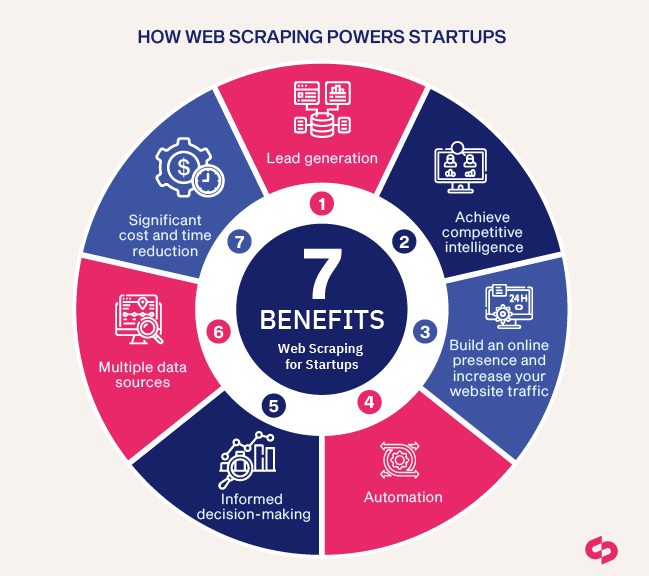
1. Lead Generation Engineering: Building Predictable Revenue Pipelines
Traditional lead generation burns capital through paid advertising, manual prospecting, and outdated contact databases. Strategic web scraping flips this model entirely.
By architecting automated lead generation systems that continuously harvest qualified prospect data from professional networks, industry directories, and competitive customer bases, startups create self-replenishing pipeline infrastructure. The competitive intelligence advantage compounds: you’re not just collecting contacts—you’re mapping entire market ecosystems, identifying decision-maker relationships, and discovering companies at precise moments of buying intent.
Advanced implementations track job changes, funding announcements, technology stack adoptions, and organizational expansions in real-time. This transforms lead generation from reactive outreach into predictive market positioning.
2. Competitive Intelligence Systems: Moving Beyond Surface-Level Analysis
Most startups monitor competitors through manual website checks and Google Alerts. This approach is fundamentally insufficient in fast-moving markets.
Sophisticated competitive intelligence through web scraping means deploying continuous monitoring systems that track pricing fluctuations, product catalog changes, promotional strategies, content positioning, customer review sentiment, and market messaging evolution. The goal isn’t simply knowing what competitors are doing—it’s understanding the strategic patterns underlying their decisions.
When you can correlate competitor pricing adjustments with their funding announcements, detect product roadmap signals from hiring patterns, and identify market positioning shifts weeks before they become obvious, you operate with a strategic foresight that fundamentally alters competitive dynamics.
3. Data-Driven Decision Architecture: Eliminating Strategic Guesswork
The difference between startups that scale and those that stagnate often comes down to decision velocity and accuracy. Web scraping creates the data infrastructure enabling both.
Real-time market data extraction means strategy sessions aren’t based on assumptions or outdated quarterly reports—they’re informed by current market realities. Product decisions reflect actual customer language and pain points scraped from review platforms. Pricing strategies respond to competitive movements detected within hours. Marketing campaigns launch with messaging validated against thousands of data points.
This isn’t about having more data—it’s about compressing the feedback loop between market reality and strategic response. Startups operating with 24-hour decision cycles outmaneuver enterprises operating on quarterly planning horizons.
4. SEO and Digital Presence Optimization: Dominating Search Landscapes
Startups face an uphill battle for digital visibility against established competitors with domain authority and content libraries. Strategic web scraping levels this playing field through intelligence-driven SEO.
By continuously scraping search engine results, trending topics, keyword performance data, and content gap analyses across your industry, you identify the exact opportunities where strategic content can capture disproportionate traffic. Understanding which queries are rising in volume, which content formats are winning featured snippets, and which semantic relationships Google is rewarding allows for surgical content strategy.
The most sophisticated approach combines scraped search intelligence with competitive content analysis—revealing not just what ranks, but why certain content architectures succeed while others fail.
5. Operational Efficiency Through Intelligent Automation
Every hour your team spends on manual data collection is an hour not spent on strategic work that actually differentiates your startup. Web scraping isn’t just about gathering information—it’s about fundamentally restructuring how your organization allocates cognitive resources.
Automated data collection, processing, and integration systems eliminate entire categories of administrative overhead. Price monitoring happens continuously without human intervention. Market research updates automatically. Competitor tracking runs 24/7. This operational leverage means five-person teams can execute market intelligence programs that would require dedicated departments at traditional companies.
The cost savings are obvious, but the strategic advantage is more profound: your team operates at a higher level of abstraction, focusing on interpretation and action rather than information gathering.
6. Multi-Source Data Synthesis: Building Comprehensive Market Models
Individual data sources provide snapshots. Multi-source data synthesis reveals the complete picture.
Strategic web scraping means aggregating information across e-commerce platforms, social media networks, financial databases, industry publications, government records, and proprietary platforms—then synthesizing these disparate data streams into coherent market intelligence.
This comprehensive view enables pattern recognition impossible with siloed data. You can correlate social media sentiment with sales trends, map supply chain signals to pricing strategies, and identify market opportunities at the intersection of multiple data dimensions. The startups that win don’t just have data—they have integrated intelligence architectures.
Navigating Web Scraping Complexity: Technical and Legal Frameworks
The Structured vs. Unstructured Data Challenge
Modern web scraping requires sophisticated approaches to data normalization. Information exists in countless formats across different platforms—structured databases, semi-structured HTML, unstructured text, multimedia content. Building extraction systems that can parse this diversity while maintaining data quality requires technical architecture beyond basic scraping scripts.
The solution lies in intelligent parsing frameworks that understand context, can adapt to structure changes, and apply domain-specific extraction logic. This transforms messy web data into clean, analysis-ready datasets.
Legal and Ethical Web Scraping Frameworks
The regulatory landscape around web scraping continues evolving, with data privacy regulations, terms of service enforcement, and intellectual property considerations creating a complex compliance environment.
Responsible web scraping means respecting robots.txt protocols, implementing rate limiting to avoid infrastructure impact, ensuring GDPR compliance for EU data subjects, understanding fair use principles, and maintaining transparency about data collection practices.
The startups that scale sustainable web scraping programs build compliance into their technical architecture from the beginning rather than treating it as an afterthought. This prevents legal exposure while maintaining ethical data practices.
Why Strategic Implementation Matters: The Scraping Pros Advantage
The gap between basic web scraping and strategic data intelligence is vast. Most startups either build fragile in-house systems that break constantly or purchase generic data that lacks competitive differentiation.
Scraping Pros delivers enterprise-grade data intelligence infrastructure specifically architected for startup velocity:
Strategic Consulting: We don’t just extract data—we design intelligence systems aligned with your specific competitive positioning and growth objectives. Every scraping implementation follows from strategic questions: What market insights create competitive advantage? Which data sources reveal opportunity before competitors notice? How do you structure data for maximum decision velocity?
Production-Grade Infrastructure: Our scraping systems handle millions of requests with sophisticated error handling, proxy rotation, CAPTCHA solving, and adaptive parsing. While basic scrapers fail when websites change, our systems automatically adjust—ensuring uninterrupted data flows.
Real-Time Intelligence Delivery: Markets move fast. We deliver processed, analysis-ready data on schedules matching your decision cycles—whether that’s hourly pricing updates, daily competitive monitoring, or real-time social media tracking.
Custom Data Engineering: Every startup has unique intelligence requirements. We build bespoke extraction pipelines, custom data models, and specialized processing workflows that deliver exactly the insights you need—not generic data dumps requiring extensive cleaning.
Compliance and Risk Management: Our legal framework ensures all data collection follows applicable regulations, respects website policies, and maintains defensible business practices. You gain competitive intelligence without legal exposure.
Scalable Architecture: As your startup grows, your data needs compound. Our infrastructure scales seamlessly from thousands to millions of data points without degrading performance or requiring architectural rebuilds.
The Strategic Imperative: Data Intelligence as Competitive Moat
Markets reward information asymmetry. When you understand customer needs, competitive positioning, pricing dynamics, and emerging opportunities better than rivals, you make systematically better decisions. These better decisions compound into sustainable competitive advantages.
Web scraping isn’t a tactical tool—it’s strategic infrastructure. The startups that recognize this early and build sophisticated data intelligence capabilities create moats that become increasingly difficult to replicate as they scale.
The question facing your startup isn’t whether to invest in web scraping, but whether you can afford to compete without the intelligence advantages it provides.
Ready to transform your startup’s strategic intelligence capabilities?
Scraping Pros specializes in architecting custom web scraping solutions that deliver competitive advantage. We’ve helped startups across industries build the data infrastructure enabling faster, smarter decisions that accelerate growth.
Let’s discuss how strategic web scraping can transform your specific market positioning and growth objectives. Contact our team to explore custom intelligence solutions designed for your startup’s unique competitive landscape.
