
Web Scraping in the Food Industry: Data Intelligence, Competitive Insights & Supply Chain Optimization
The food industry is undergoing rapid transformation, driven by the need for accuracy, efficiency, and real-time decision-making. As competition intensifies and consumer expectations evolve, companies increasingly rely on web scraping to extract the food industry data needed to stay ahead. From pricing analysis to market forecasting, web scraping in the food industry has become a strategic advantage for brands looking to innovate, optimize operations, and remain profitable.
Modern web scraping tools allow businesses to gather essential insights from e-commerce platforms, delivery apps, supplier websites, and consumer review channels. This influx of real-time information empowers food brands to strengthen competitive intelligence, improve customer satisfaction, and enhance supply chain optimization across all stages of production and distribution.
In this article, we explore the most impactful applications of web scraping, the benefits for food companies, and how data-driven intelligence is reshaping today’s food economy.
Why Web Scraping Matters in Today’s Food Industry
The food sector is vast and highly fragmented, involving manufacturers, distributors, restaurants, retailers, and logistics providers. While the industry grows steadily, profit margins remain narrow, and competition continues to intensify. To thrive, businesses must leverage real-time food industry data to anticipate market shifts, understand consumer behavior, and optimize costs.
This is where web scraping tools become invaluable. By automating data extraction, companies gain access to accurate, fresh, and actionable intelligence that supports smarter decision-making in a fast-changing environment.
Key Use Cases of Web Scraping in the Food Industry
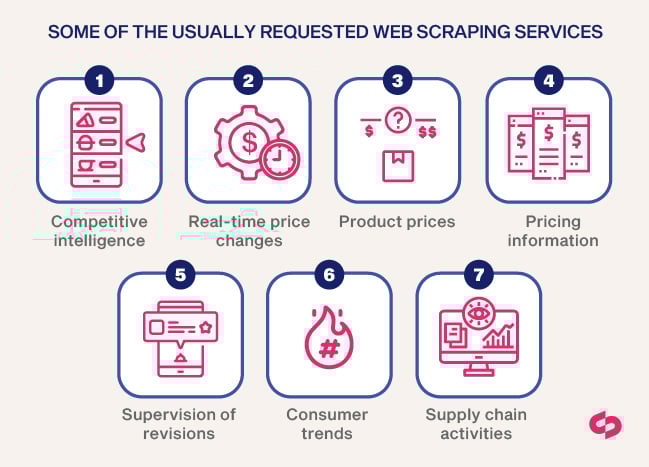
Key Use Cases of Web Scraping in the Food Industry
1. Competitive Intelligence for Food Businesses
Staying competitive requires visibility into market movements, competitor strategies, and pricing behaviors. Web scraping provides continuous access to:
-
Competitor product catalogs
-
Real-time pricing changes
-
Promotions and seasonal campaigns
-
Customer feedback trends
With this competitive intelligence, companies can fine-tune their pricing strategy, adjust promotional timing, or introduce new offerings that better align with consumer expectations.
LSI keywords: market analysis, competitor tracking, food pricing intelligence
2. Real-Time Price Monitoring
Speed is essential in pricing decisions. Prices shift constantly due to supply availability, seasonal demand, and competitor actions. Web scraping helps companies monitor:
-
Ingredient costs
-
Retail and restaurant menu prices
-
Delivery platform pricing
-
Discount fluctuations
The ability to track real-time pricing enables businesses to maintain competitiveness, protect margins, and forecast future pricing patterns using historical data.
LSI keywords: dynamic pricing, food cost analysis, real-time market data
3. Understanding Consumer Trends
Consumer preferences evolve quickly—from dietary habits to flavor preferences and product expectations. Web scraping tools offer insights into consumer trends by collecting data from:
-
Social media conversations
-
Review platforms
-
Discussion forums
-
Search trends
A restaurant chain, for example, can identify which dishes generate the most excitement online, helping them refine menus, launch limited-time items, or retire low-performing products.
LSI keywords: customer sentiment, consumer behavior insights, food trend analytics
4. Supply Chain Optimization
Food supply chains are complex, involving farmers, producers, distributors, and retailers. Any disruption can ripple across the system. Web scraping enhances supply chain optimization by monitoring:
-
Availability of raw materials
-
Supplier pricing
-
Delivery times
-
Stock levels across multiple platforms
This helps companies improve procurement, mitigate risks, and maintain continuity in production and distribution.
LSI keywords: logistics intelligence, supplier monitoring, inventory optimization
5. Customer Feedback & Sentiment Analysis
Reviews and ratings provide rich, unfiltered insights into customer satisfaction. Scraping customer feedback enables companies to detect:
-
Recurring complaints
-
Packaging or delivery issues
-
Taste or quality concerns
-
Positive patterns that support marketing efforts
With this data, businesses can make targeted improvements, enhance customer experience, and strengthen brand reputation.
LSI keywords: sentiment analysis, customer feedback insights, review monitoring
6. Price Comparison & Product Data Extraction
Food brands often need to benchmark product information across different platforms. Web scraping enables detailed comparisons of:
-
Pricing
-
Nutritional information
-
Packaging
-
Ingredient lists
-
Certifications (organic, gluten-free, non-GMO)
This helps businesses stay competitive and compliant with industry regulations.
LSI keywords: product benchmarking, food label data, competitive pricing comparison
Key Benefits of Web Scraping for Food Businesses
1. Smarter, Data-Driven Decisions
With consistent access to fresh food industry data, companies can optimize pricing, marketing, supply chain planning, and product launches.
2. Greater Operational Efficiency
Automated data extraction eliminates manual research, saving time and resources while providing high-quality, structured data.
3. Competitive Advantage
Continuous monitoring of competitors and market sentiment strengthens a company’s ability to react quickly and strategically.
4. Enhanced Customer Experience
By understanding consumer trends and preferences, businesses can deliver more relevant products and improve customer loyalty
Getting Started with Web Scraping for the Food Industry
Food companies can develop internal scraping technology or partner with experts who specialize in managed scraping services. Scraping Pros provides tailored solutions that deliver clean, structured, and actionable data collected across multiple online sources—without the technical burden or compliance risks.
Working with a professional partner ensures scalable infrastructure, advanced anti-detection capabilities, and reliable data pipelines.
Conclusion
Web scraping has become an essential capability for modern food businesses. By providing real-time insights into pricing, competition, consumer behavior, and supply chain performance, it empowers companies to innovate, stay competitive, and operate with greater precision.
For organizations looking to leverage web scraping in the food industry, Scraping Pros offers expert-driven, fully managed solutions designed to support long-term growth and data-driven success.
