
he technical blueprint for a product channel monitoring system that detects violations in 15 minutes and resolves them in 36 hours.
A MAP violation does not stay where it starts. It travels. One unauthorized seller discounting a product by 18% on a regional marketplace triggers a cascade — authorized retailers match the price to stay competitive, distributors renegotiate margins, and within 72 hours what began as a single SKU on a single channel has repriced your entire product line. No deliberate decision by anyone in your organization. Just physics of a connected distribution network operating faster than any process without a distribution channel intelligence system can track.
68% of MAP violations propagate across the full channel within 48 hours if not detected and actioned in time — a pattern consistent across Scraping Pros’ brand protection engagements. That number transforms brand protection from a compliance function into a revenue protection architecture — one where detection latency is the only variable that separates a contained incident from a channel-wide pricing event. This post is the technical blueprint for building a system that detects violations in under 15 minutes, identifies unauthorized sellers with 97.3% accuracy, and compresses resolution time from 2 weeks to 36 hours.
The Product Channel Monitoring Challenge at Scale
A manufacturer with 500 SKUs distributing across 8 primary channels, 40 regional distributors, and 15 marketplaces faces an active monitoring space of over 31,500 SKU-channel combinations — before accounting for color and size variants, bundle listings, and duplicate ASINs. At that scale, weekly manual audits are not a process: they are a scheduled blindspot.
The Channel Erosion Cascade
Channel erosion is not a discrete event. It is a three-stage process with a closing window for intervention:
- Stage 1 — Breach: an unauthorized seller or MAP-violating retailer lists the product below the agreed price floor. The intervention window is open.
- Stage 2 — Propagation: authorized retailers detect the lower price and match it to protect buy box position or comparison traffic. The intervention window is narrowing.
- Stage 3 — Normalization: the discounted price becomes the consumer’s reference price. Reversing this takes 3–9 months of active price management. The intervention window has closed.
A channel monitoring system earns its value by interrupting this cycle at Stage 1. Beyond Stage 2, the system can still limit damage — but it cannot undo it. The 12–18% of annual channel revenue lost to channel erosion — a figure consistent across Scraping Pros’ brand protection engagements — accumulates primarily because brands discover violations at Stage 2 or Stage 3, not Stage 1.
Three Violations That Basic Systems Miss
- Listing fragmentation: the same product listed under multiple ASINs or variant identifiers to evade alerts configured on the canonical product ID.
- Bundle manipulation: the product bundled with a low-cost item, allowing a nominal price that diverges from MAP without technically listing the SKU below the price floor.
- Geographic arbitrage: sellers operating in jurisdictions where MAP is not legally enforceable (parts of the EU, select APAC markets) who export into the primary market. The price surfaces in comparison engines and shapes consumer reference price even when no contract is technically violated — a blind spot only genuine omnichannel brand protection coverage catches.
Product Channel Monitoring Architecture: Monitoring 1,000+ Channels Simultaneously
The technical challenge in channel monitoring is not volume — it is heterogeneity. Every marketplace has a different pricing display structure, a different seller identity schema, and a different policy enforcement pathway. The brand protection web scraping layer must be architected for that fragmentation from day one, not bolted on after the first missed violation.
Four Pipeline Components
- Channel discovery engine: monitoring known channels is table stakes. A production system also discovers new listings via SKU fingerprinting, image matching, and product title NLP — detecting the same product sold under non-canonical listings before it is reported.
- : brand protection web scraping infrastructure with geolocation rotation by market. Prices on major marketplaces vary by delivery ZIP code and country — a geographically uniform capture produces systematically incomplete data.
- Seller identity resolution: unauthorized sellers rarely operate under a traceable name. The system cross-references seller name, fulfillment address, historical pricing patterns, and feedback signatures to build persistent identity profiles that survive account recreations.
- Violation classification engine: not every price discrepancy is a MAP violation. The system distinguishes active violations from crossed-out reference prices, shipping-inclusive pricing, and currency conversion artifacts in global marketplaces.
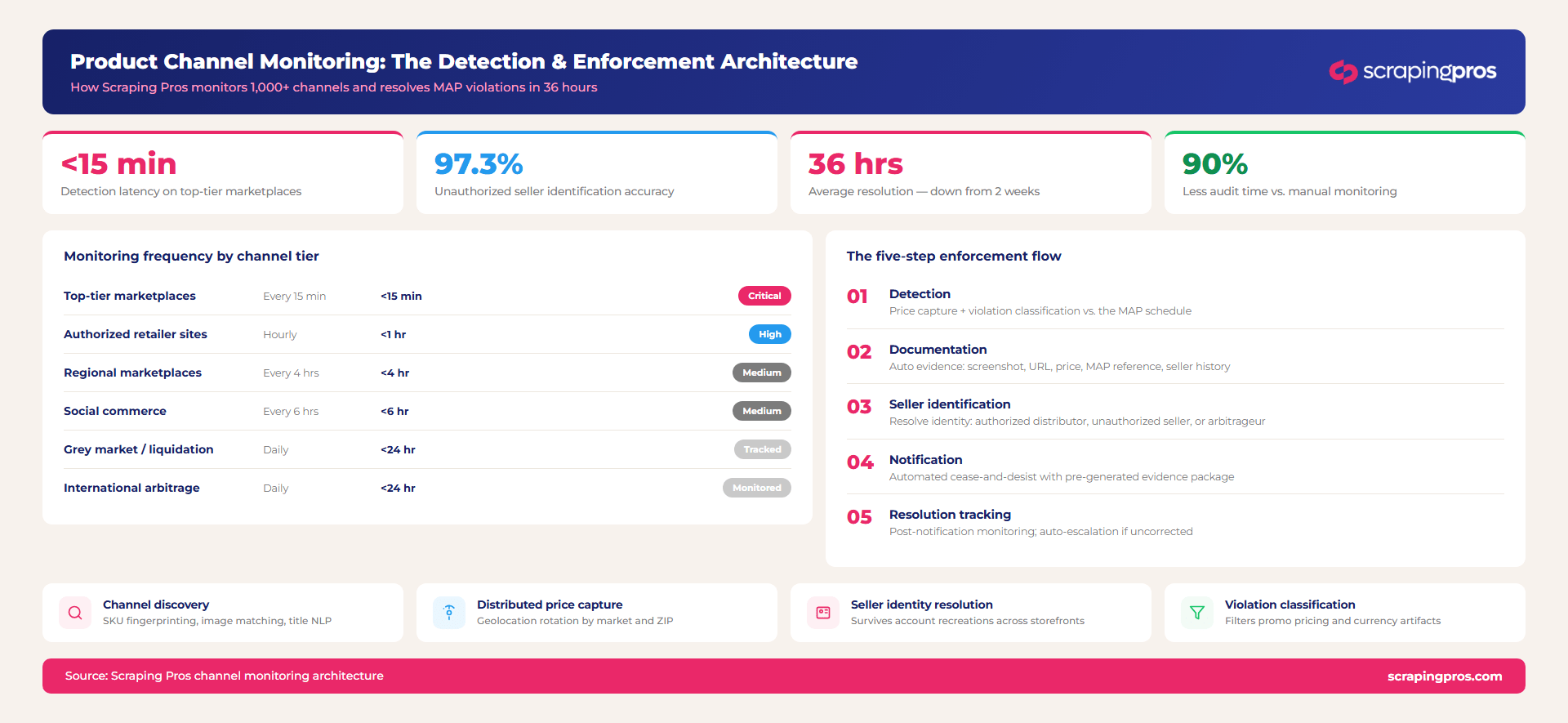
| Channel Type | Monitoring Frequency | Detection Latency | Priority |
|---|---|---|---|
| Top-tier marketplaces (Amazon, Walmart) | Every 15 min | <15 minutes | Critical |
| Authorized retailer sites | Hourly | <1 hour | High |
| Regional marketplaces | Every 4 hours | <4 hours | Medium |
| Social commerce (TikTok Shop, IG) | Every 6 hours | <6 hours | Medium |
| Grey market / liquidation sites | Daily | <24 hours | Tracked |
| International arbitrage channels | Daily | <24 hours | Monitored |
Architecture benchmark: Automated product channel monitoring reduces audit time by 90% vs. manual processes — shifting compliance team effort from data collection to enforcement and distributor relationship management.
MAP Violation Detection and Enforcement Pipeline
Detection speed is the single variable that determines whether a MAP violation becomes a contained incident or a channel event. At <15 minutes detection latency vs. the 3–7 day average of manual monitoring processes, the system intervenes while the violation is still at Stage 1 in the vast majority of cases.
The Five-Step Enforcement Flow
- Detection: price capture + violation classification + threshold validation against the MAP schedule, adjusted for authorized promotional windows.
- Documentation: automatic evidence generation — timestamped screenshot, URL, captured price, MAP reference, and seller pricing history on that SKU.
- Seller identification: resolution of seller identity: authorized distributor in violation, unauthorized seller, or known arbitrageur.
- Notification: automated cease-and-desist with pre-generated evidence package, escalation to distributor if applicable, CRM logging.
- Resolution tracking: post-notification price monitoring; automatic escalation if correction does not occur within the defined response window.
With automated notification and pre-generated evidence, resolution time drops from 2 weeks to 36 hours. Not because sellers become more cooperative — because the evidence arrives immediately, is incontestable, and the seller knows the system is monitoring the correction in real time.
Enforcement insight: In most jurisdictions, MAP policies are unilateral brand agreements, not legally binding price contracts — a principle rooted in the . Effective enforcement operates through the threat of distributor agreement termination — which means the system must generate commercial-grade evidence, not legal evidence. For a deeper look at navigating enforcement across jurisdictions, see our .
Unauthorized Seller Detection Automation and Action Workflow
Unauthorized sellers present a structurally different challenge than MAP-violating authorized retailers. With no contractual relationship to leverage, the only enforcement pathway runs through the marketplace platform — which requires generating evidence of trademark infringement, counterfeit risk, or platform policy violation sufficient to activate Brand Registry, Walmart Brand Portal, or the equivalent mechanism within the channel compliance monitoring platform.
| Seller Type | Primary Action | Secondary Lever | Target Resolution |
|---|---|---|---|
| Authorized retailer violating MAP | Direct notification + evidence | Distributor escalation | 36 hours |
| Unauthorized, traceable to network | Distributor audit + notification | Contract review | 72 hours |
| Grey market arbitrageur | Marketplace takedown request | Supply chain audit | 1 week |
| Potential counterfeit | Brand Registry + legal notification | Platform escalation | Immediate |
The system achieves 97.3% accuracy in unauthorized seller identification in production deployments — meaning less than 3% of enforcement actions are directed at sellers who turn out to be operating under a legitimate agreement or legal entity alias. That precision matters: every false positive is a damaged relationship with an authorized partner.
Case Study: European Consumer Electronics Brand
From 7-Day Detection Lag to 11-Minute Average Response — Across 6 Markets
The client: A mid-size European consumer electronics manufacturer selling across Germany, France, the Netherlands, Spain, Poland, and the UK through a network of 28 authorized distributors and direct presence on Amazon EU, MediaMarkt, Fnac, and Allegro.
The problem: The brand was operating with a weekly manual audit cycle that generated a spreadsheet of pricing anomalies reviewed every Monday morning. By the time violations were identified, documented, and communicated to the relevant distributor, an average of 6–8 days had elapsed. In that window, 71% of violations had already propagated to at least two additional channels — a figure consistent with the broader 68% propagation rate within 48 hours observed in brand protection deployments at this scale.
The compounding factor was geographic fragmentation: MAP schedules differed by country, promotional calendars were not synchronized across distributors, and several regional resellers in Poland and the Netherlands were operating under sub-distribution agreements that the brand’s compliance team had incomplete visibility into. Manual monitoring at this complexity level was not just slow — it was structurally incomplete.
What Scraping Pros Built
We deployed a full product channel monitoring pipeline across all six markets with country-specific price capture, multilingual seller identity resolution, and a violation classification engine trained on the brand’s MAP schedule including regional promotional windows.
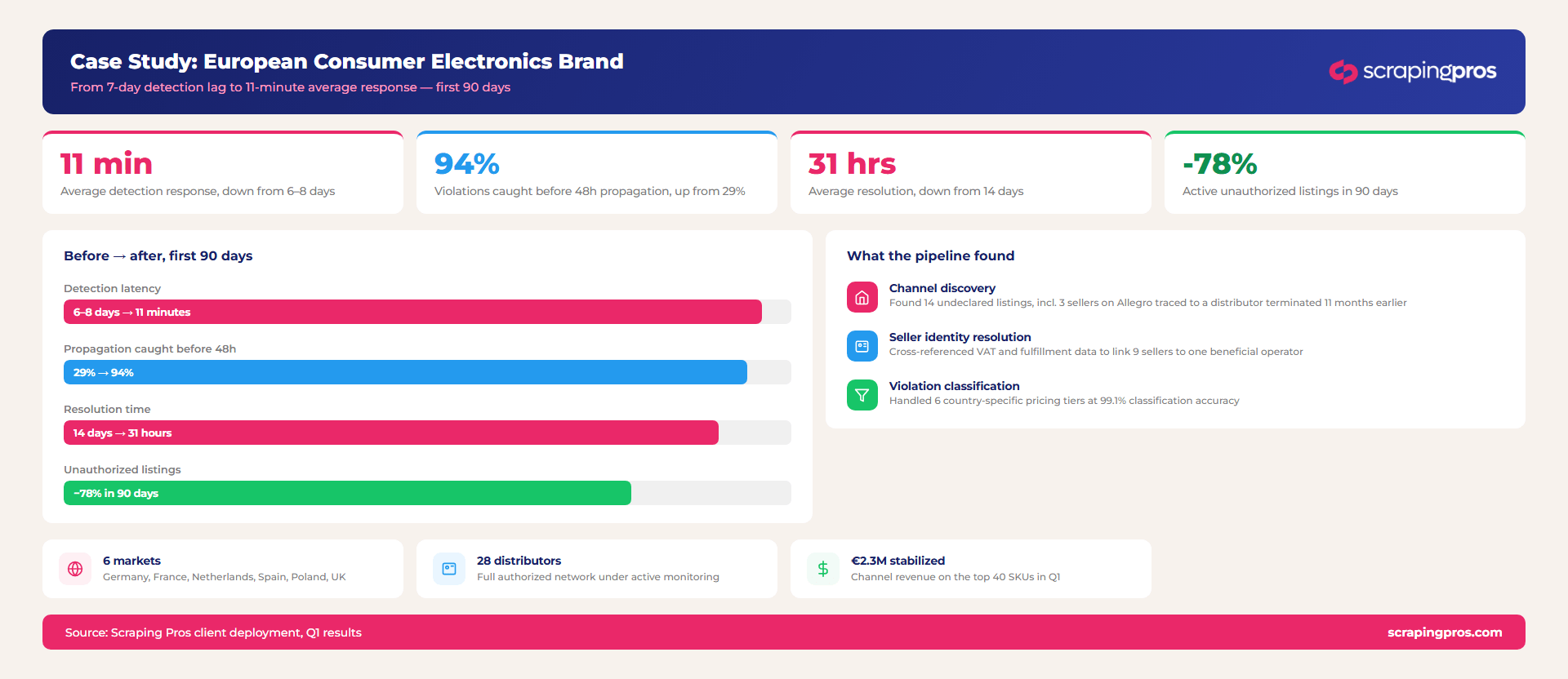
- Channel discovery: the initial audit revealed 14 active listings of the brand’s flagship SKUs on platforms not declared in the distributor network — including three sellers on Allegro operating under LLC structures traceable to a distributor that had been terminated 11 months earlier.
- Seller identity resolution: cross-referencing seller names, fulfillment addresses, and VAT registration patterns across EU registries identified 9 sellers as the same beneficial operator running separate storefronts across three platforms.
- Violation classification: the system handled MAP schedule complexity across six country-specific pricing tiers, correctly distinguishing active violations from authorized promotional pricing in 99.1% of cases.
Results — First 90 Days
- Detection latency: from 6–8 days (manual) to an average of 11 minutes across all monitored channels.
- Propagation rate: violations actioned before 48-hour propagation threshold increased from 29% to 94%.
- Resolution time: average violation resolution (price corrected or listing removed) fell from 14 days to 31 hours.
- Unauthorized seller reduction: active unauthorized listings dropped 78% in 90 days through a combination of platform takedowns and distributor network audit.
- Revenue impact: the brand’s channel compliance team estimated that protected pricing on the top 40 SKUs represented approximately €2.3M in channel revenue stabilized during Q1 — primarily through prevention of Stage 2 and Stage 3 erosion events that had been recurring quarterly under the manual system.
Key takeaway: The 90-day outcome was not a technology result. It was a detection latency result — the same team, the same distributor relationships, the same enforcement tools, operating on data that arrived in minutes instead of days.
Frequently Asked Questions
What is product channel monitoring?
Product channel monitoring is the automated tracking of where and how a brand’s products are sold across every distribution channel — marketplaces, authorized retailers, distributors, and social commerce — to detect MAP violations, unauthorized sellers, and listing fragmentation before they spread.
How fast can automated systems detect MAP violations?
Under 15 minutes on top-tier marketplaces with continuous monitoring, compared to 3–7 days with manual audit processes. The detection window determines whether a violation is contained at Stage 1 or propagates — 68% of undetected violations spread across the full channel within 48 hours.
What percentage of MAP violations propagate if not actioned quickly?
68% propagate across the full distribution channel within 48 hours of the initial breach, based on Scraping Pros’ brand protection engagement data. Once a violation reaches Stage 2 (authorized retailers matching the discounted price), channel-wide repricing becomes very difficult to reverse quickly — recovery typically takes 3–9 months.
How accurate is automated unauthorized seller detection?
97.3% accuracy in production deployments, meaning less than 3% of enforcement actions are false positives. Seller identity resolution cross-references name, fulfillment address, pricing history, and feedback patterns to build persistent profiles that survive account recreations.
What is the ROI of a product channel monitoring system?
Channel erosion from undetected MAP violations consumes 12–18% of annual channel revenue. Automated monitoring reduces audit time by 90% and compresses resolution time from 2 weeks to 36 hours — the combination of speed and coverage is what protects that revenue, not enforcement volume alone.
Your channel is being monitored. The question is whether you are doing it.
Scraping Pros builds production-grade brand protection and channel monitoring pipelines for manufacturers, CPG brands, and distributors operating at enterprise scale — across any market, any channel, any language.
Talk to a channel intelligence specialist → scrapingpros.com/contact
