
How Web Scraping Supercharges E-Commerce Data Extraction in 2025
Introduction
E-commerce is evolving faster than ever. Competition is fiercer, customer expectations are higher, and product cycles are shorter. In this environment, the companies winning today are those that master real-time data extraction—not once a month, not once a week, but continuously.
This is where web scraping becomes a strategic advantage rather than just a technical tool. Modern scraping solutions allow e-commerce teams to automate data collection at scale, uncover market shifts earlier, and power smarter decisions across pricing, product development, SEO, inventory and customer experience.
In this article, we break down how enterprise-grade web scraping reshapes e-commerce operations, the strategic benefits it provides, and the high-impact use cases already driving competitive differentiation in 2025.
What Is Web Scraping in E-Commerce Today?
Web scraping is the automated extraction of structured data from websites. For e-commerce, this typically includes:
-
Product pricing and availability
-
Customer reviews and sentiment
-
Category-level trends
-
Competitor product launches
-
Marketplace changes (Amazon, Walmart, eBay, Mercadolibre, etc.)
-
Promotional activity and discounting
-
Social, behavioral, and demand signals
While early scraping methods were manual and slow, modern infrastructures—like headless browsers, smart proxies, CAPTCHA-resistant systems, and ML-based extractors—now deliver clean datasets in minutes rather than days. This shift has made scraping a mission-critical capability for any data-driven retailer.
Why Leading E-Commerce Brands Rely on Web Scraping
1. Massive Efficiency Through Automation
Collecting pricing, competitor data or marketplace insights manually is simply unsustainable. Automated scraping:
-
Reduces data collection time from hours to seconds
-
Eliminates human error
-
Keeps datasets fresh 24/7
-
Frees teams to focus on analysis, not extraction
For companies managing thousands—or millions—of SKUs, automation is the only scalable option.
2. Real-Time Competitive and Market Visibility
Markets move quickly. Prices fluctuate hourly. Inventory levels shift constantly. Consumer behavior evolves daily.
Web scraping provides live visibility into:
-
Competitor price changes
-
New product launches
-
Shifts in demand signals
-
Consumer preferences across marketplaces
This allows e-commerce teams to act before competitors can.
3. High-Quality Lead & Prospect Data
Scraping public sources—business directories, marketplaces, social platforms, B2B listings—empowers e-commerce brands to:
-
Build targeted prospect lists
-
Identify high-intent buyers
-
Personalize outreach campaigns
-
Improve conversion rates
Instead of guessing who to target, scraping gives you the data to target with precision.
4. Smarter Product Research & Development
User reviews, ratings, feature comparisons, and trend signals are gold for product teams.
Scraping provides clarity on:
-
What customers love
-
What customers hate
-
Which features outperform
-
Gaps in the market
-
Opportunities for innovation
Better data → better product decisions → better revenue outcomes.
Top 10 Use Cases of Web Scraping for E-Commerce Businesses
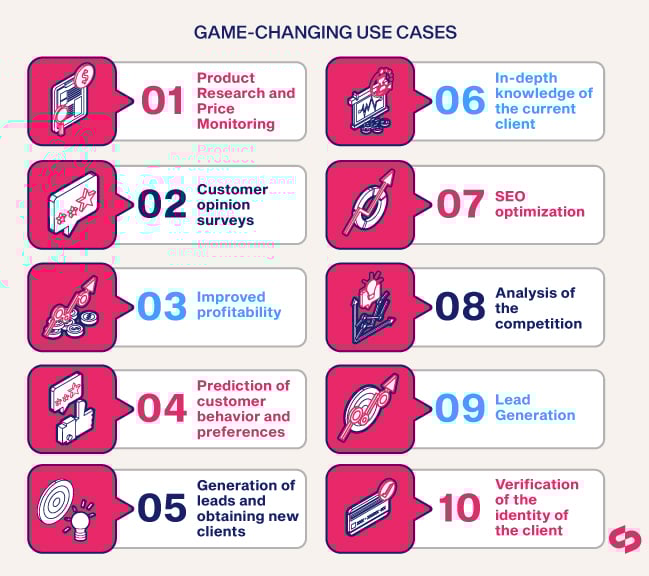
1. Price Monitoring and Competitive Analysis
One of the most powerful applications of web scraping is in price monitoring. E-commerce businesses can scrape competitor websites to track how they price their products in real time. This data can be used to adjust pricing strategies, ensuring that your products remain competitive in the marketplace. Scraping tools can gather competitor pricing, product descriptions, and even sales promotions, providing a comprehensive view of the competitive landscape.
2. Product Research and Trend Analysis
Web scraping allows businesses to track emerging trends by gathering data on new products, features, and customer preferences. For example, scraping product listings on major e-commerce platforms can reveal what’s trending, helping businesses stay ahead of the curve by offering popular products or launching timely promotions.
3. Customer Feedback and Sentiment Analysis
Customer feedback is crucial in shaping your e-commerce business. Scraping reviews from online platforms can help you understand customer sentiment, identify pain points, and recognize what your customers love about your products. Sentiment analysis tools can also help process large volumes of customer opinions, enabling businesses to make data-driven decisions to improve products or services.
4. Lead Generation and Data Collection
As mentioned, lead generation is an essential part of e-commerce growth. Web scraping can be used to collect valuable data, such as company names, contact details, and social media profiles, to create a targeted lead list. This data can then be integrated with email campaigns, marketing funnels, or CRM systems to increase conversion rates.
5. SEO Optimization
E-commerce businesses can use web scraping to optimize their websites for better search engine ranking. By analyzing keyword usage and SEO performance on competitor sites, web scrapers can help identify which keywords are driving traffic to specific pages. This data can be used to optimize product descriptions, blogs, and content marketing strategies to boost organic visibility.
6. Inventory Management
Web scraping can also assist with inventory management. By scraping product availability and pricing data from competitor websites, e-commerce businesses can gauge whether they need to adjust their own stock levels. Monitoring inventory helps ensure that businesses don’t overstock or run out of popular items, thus preventing revenue loss.
7. Personalized Marketing
Web scraping can provide insights into consumer preferences, behaviors, and purchase history. By analyzing scraped data, businesses can personalize their marketing efforts, tailoring advertisements, product recommendations, and promotions to specific customer segments. Personalized marketing leads to higher customer engagement and conversion rates.
8. Fraud Prevention
Scraping tools can also be used to monitor for potential fraudulent activities on e-commerce websites. By scraping product listings, reviews, and user interactions, businesses can identify suspicious patterns or fake reviews that could harm their reputation or mislead customers. This helps maintain a trustworthy and reliable online presence.
9. Social Media Insights
Web scraping allows businesses to gather data from social media platforms such as Facebook, Instagram, or Twitter. By scraping posts, hashtags, and discussions, companies can track social sentiment around their products and competitors, gain insights into customer interests, and create content that resonates with their audience.
10. Sales and Revenue Prediction
Web scraping can help e-commerce businesses predict future sales and revenue by analyzing consumer behavior, product trends, and seasonal fluctuations. By leveraging predictive analytics and historical data, businesses can forecast demand and adjust their strategies accordingly, optimizing inventory and pricing for maximum profit.
Conclusion: How Web Scraping Transforms Your E-Commerce Business
In today’s competitive e-commerce landscape, staying ahead of the curve requires access to high-quality data. Web scraping is the solution that enables businesses to collect, analyze, and leverage vast amounts of data in real time. By automating the process of data extraction, web scraping provides e-commerce businesses with the insights needed to make informed decisions, optimize operations, and improve customer experiences.
From price monitoring to personalized marketing, the applications of web scraping in e-commerce are vast and varied. As web scraping technology continues to evolve, it’s clear that it will remain an essential tool for businesses looking to maximize their potential in a digital-first world.
If you’re ready to harness the power of web scraping for your e-commerce business, Scraping Pros offers tailored solutions to meet your data extraction needs. Get in touch today to explore how we can help you optimize your e-commerce operations and gain a competitive edge.
