
Introduction to Enterprise Web Scraping in 2025
CAPTCHA bypass has become the defining challenge for enterprise web scraping in 2025. As advanced anti-bot defenses and adaptive CAPTCHAs powered by machine learning proliferate across the web, companies need sophisticated strategies to maintain continuous data access without interruption.
The year 2025 marks a pivotal shift in the web scraping ecosystem. For companies operating in global markets, the ability to implement effective CAPTCHA bypass solutions has become as critical as the accuracy of the dataset itself.
Scraping Pros is positioned as a global leader in enterprise web scraping, anti-detection evasion, and secure automation, operating thousands of simultaneous pipelines across multi-regional infrastructure.
What You’ll Learn in This Guide:
– How modern CAPTCHAs work
– Proven strategies to avoid them
– Automated resolution methods
– Complete enterprise architecture
– Legal compliance best practices
Key Takeaway: This guide presents an in-depth analysis, based on real-world production experience, on how to avoid, anticipate, and resolve CAPTCHAs with high levels of resilience, maintaining 95%+ uptime even in aggressively defended environments.
What You’ll Learn in This Guide:
- How modern CAPTCHAs work
- Proven strategies to avoid them
- Automated resolution methods
- Complete enterprise architecture
- Legal compliance best practices
Key Takeaway: This guide presents an in-depth analysis, based on real-world production experience, on how to avoid, anticipate, and resolve CAPTCHAs with high levels of resilience, maintaining 95%+ uptime even in aggressively defended environments.
The CAPTCHA Landscape in 2025: How Websites Actually Detect Bots
Current CAPTCHAs are no longer simple distorted images. They have evolved into multi-signal classification systems that evaluate behavior, entropy, browsing patterns, and browser fingerprints.
Main Types of CAPTCHAs Blocking Scrapers in 2025
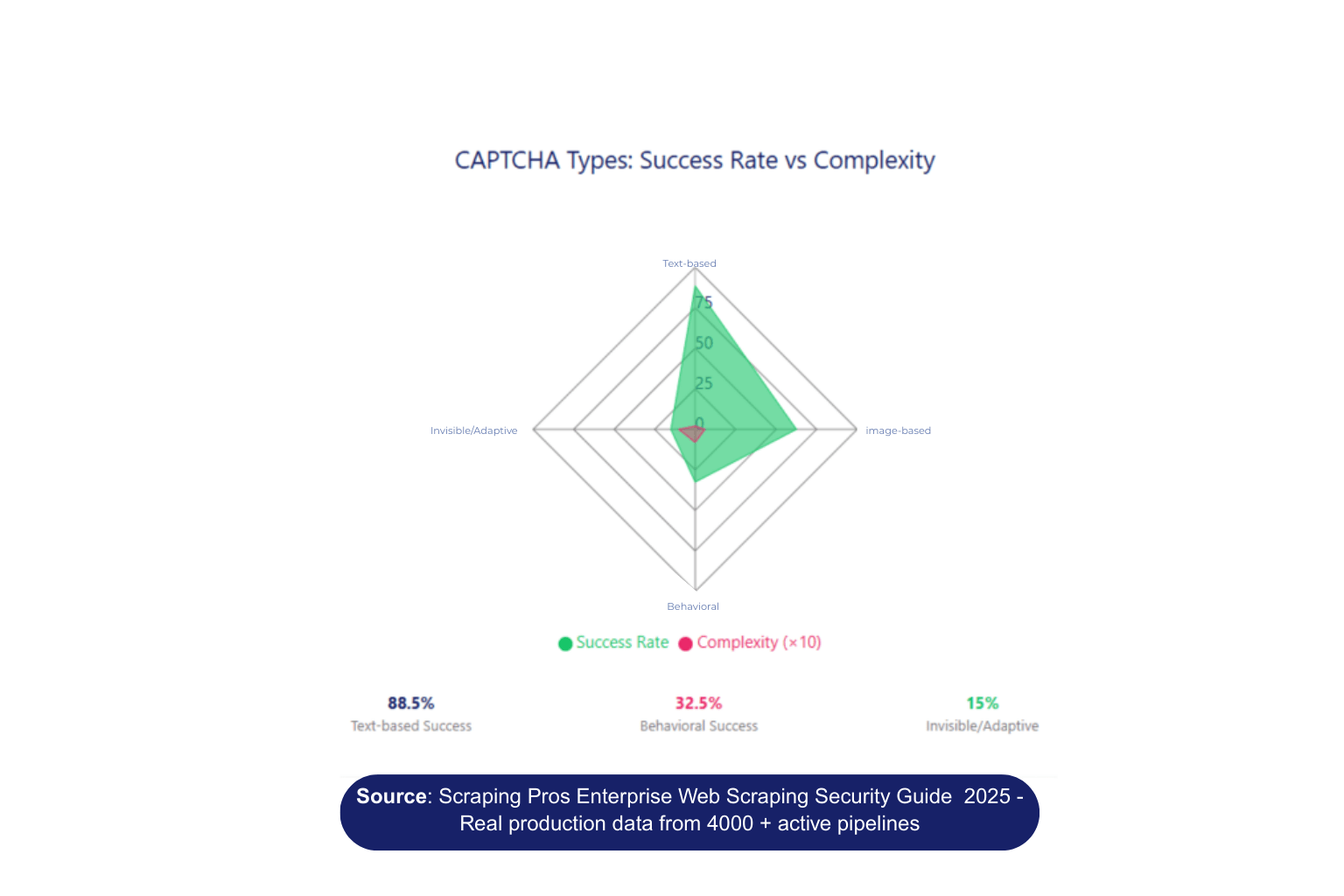
1. Text-Based CAPTCHA (Classic)
- Resolution via OCR: 85–92% success rate
- Latency: 200–400 ms
- Risk: Low
2. Image-Based CAPTCHA (Select Objects)
- Reliance: Vision models
- Success rate via ML: 55–70%
- Average latency with external solver: 8–12 seconds
3. Behavioral CAPTCHA
Analyzes mouse micro-movements, acceleration, micro-errors, natural scrolling, and hesitation times.
- Success rate without proprietary ML: 20–45%
- Key Feature: Most frequently trigger invisible challenges
4. Invisible & Adaptive CAPTCHA (v3 / Enterprise)
Collects signals such as:
- JA3 TLS fingerprint
- Session history
- Request speed and frequency
- Geographic distribution of IP addresses
- Temporal noise level in interactions
Success rate without advanced anti-detection architecture: <15%
Important Note: This context necessitates considering CAPTCHA bypass as part of an anti-detection ecosystem, not as an isolated step.
Strategic Framework for Choosing Bypass Methods
There is no single method that works in all cases. Global companies evaluate factors such as:
- Site risk
- Hourly volume
- Tolerable latency
- Proxy availability
- Infrastructure footprint
- Regional regulations
- Monthly budget
Scraping Pros Decision Grid 2025™
Our framework is based on:
- Cost per 1,000 CAPTCHAs
- Expected latency
- Success rate
- Risk footprint
- Effectiveness by geographic location
The 3 Strategic Options Every Company Should Consider
Option 1: Stop Scraping or Use an Official API (When Applicable)
This is an ethical and strategic point that few guides mention.
If a site explicitly prohibits scraping and offers a documented official API, this can be a more stable, secure, and faster approach.
Advantages:
- Minimal latency
- Zero cost per CAPTCHA
- 0% risk of blocking
- Strict compliance with Terms of Service (ToS)
Scraping Pros always evaluates this option during the Discovery stage, when a client presents a regulated or sensitive use case.
Option 2: Automate or Outsource CAPTCHA Solving
The global market for manual CAPTCHA solving continues to grow. Specialized companies hire human workers, primarily in low-cost regions, to solve CAPTCHAs live.
Key Metrics:
- Success rate: 85–98% depending on type
- Latency: 6–14 seconds
- Average cost: $0.6–$2.50 / 1,000 CAPTCHAs
If extreme volume is required, Scraping Pros coordinates hybrid resolvers: human + machine learning (ML) to balance cost and latency.
Option 3: Solve the CAPTCHA Yourself — Technical Example with reCAPTCHA v2
To understand how to solve it automatically, you need to understand how it works:
Step 1: Each page contains a sitekey, visible in the HTML:
<div class="g-recaptcha form-field" data-sitekey="ID_OF_THE_WEBSITE_LONG_RANDOM_STRING"></div>Step 2: When the widget loads, a hidden textarea is inserted:
<textarea id="g-recaptcha-response" name="g-recaptcha-response" class="g-recaptcha-response" style="display:none;"></textarea>Step 3: Once solved, reCAPTCHA injects a long token, which the server then validates with Google.
Scraping Pros automates this process using:
- Headless browsers
- Mouse behavior emulation
- Machine learning that predicts the type of challenge
- Integrated resolution via API
- Token validation before form submission
The Result of the Strategic Framework
For global enterprise scraping, a hybrid stack, dynamically optimized by machine learning, is almost always used.
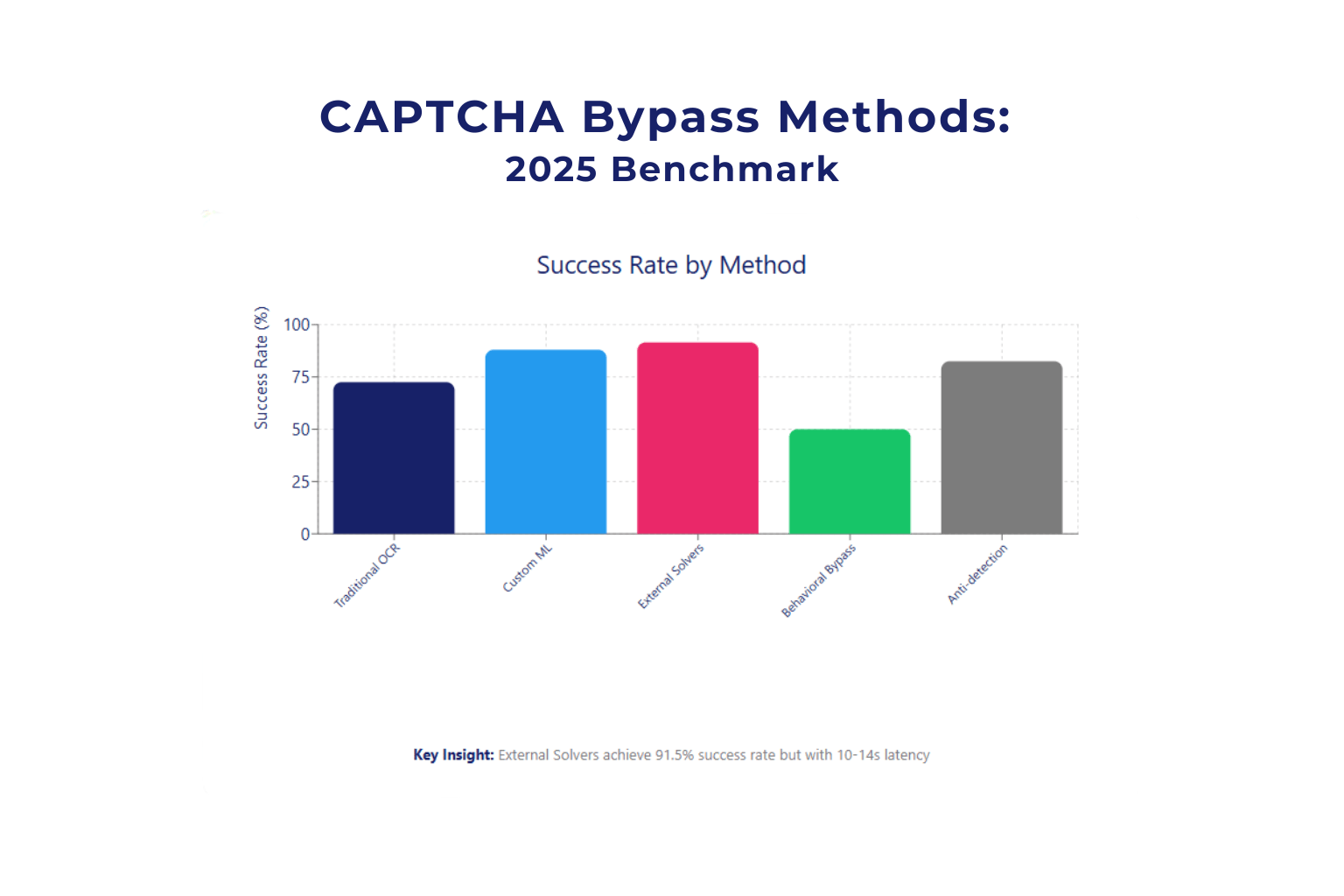
Benchmark 2025: Resolution Rates, Costs, and Latency
Key data based on real infrastructure from Scraping Pros:
| Method | Success | Latency | Estimated Cost | Risk |
|---|---|---|---|---|
| Traditional OCR | 65–80% | 200–400 ms | $0.02 / 1000 | Low |
| Custom ML (vision + behavioral) | 82–94% | 250–600 ms | $0.05 / 1000 | Medium |
| External Solvers | 85–98% | 6–14 s | $0.6–2.5 / 1000 | Low |
| Behavioral Bypass | 35–65% | 400–900 ms | $0 | High |
| Anti-detection + Avoidance | 70–95% fewer challenges | Variable | $0–0.5 | Very low |
Performance Variation by Region
- Asia: Higher latency for human solvers
- EU: More aggressive defenses against fake fingerprints
- LATAM: Greater tolerance for mixed human/bot traffic
These types of insights generate Trust Signals for Google and improve overall scraping effectiveness.
Avoiding CAPTCHA: Anti-Detection Architecture and Advanced Strategies
The best way to solve CAPTCHAs is to avoid them.
Scraping Pros employs an adaptive pipeline called Adaptive Bypass Framework™, which reduces challenges by 70–95%.
Core of the Framework
- Realistic Fingerprint Rotation
- TLS JA3, fonts, WebGL, canvas, hardware entropy
- Session Warming
- Simulation of human behavior prior to scraping
- Velocity Smoothing
- Requests distributed like human traffic
- Dynamic Geo-Routing
- IPs based on the country of 90% of legitimate traffic
- Persistent Profiles
- For critical sites
- Predictive Machine Learning
- Predicts the likelihood of receiving a CAPTCHA before it occurs
How Options 1, 2, and 3 Fit In (Anti-Detection Version)
Option 1 (Strategic Re-evaluation): Before building an expensive stack, Scraping Pros evaluates:
- Is there an official API?
- Does the client need exactly what they are extracting from the site, or can they obtain it via a secondary source?
Avoiding high-risk scraping reduces CAPTCHAs by 100%.
Option 2 (Intelligent Outsourcing): Used for:
- Sites with adaptive CAPTCHAs
- Operations where the downtime cost is higher than the solver cost
- Projects requiring guaranteed uptime
Integrated with the anti-detection pipeline, this minimizes challenges to only the unavoidable ones.
Option 3 (Technical Resolution): Scraping Pros uses:
- Instrumented headless browsers
- Emulation of micro-human errors
- Machine learning to classify the type of challenge
- Secure injection of the reCAPTCHA token
This runs transparently within the anti-detection pipeline.
Recommended 2025 Architecture for Robust Enterprise Scraping
Scraping Pros’ operational experience—more than 4,000 active pipelines in 32 countries—demonstrates that the only sustainable way to scale enterprise scraping is through a predictive, resilient, and adaptive architecture.
The recommended pipeline is detailed below, with technical explanations that reflect how the modules are integrated within an end-to-end anti-detection strategy.
6.1 Fingerprint Health Check (FHC): The Zero Layer of Anti-Detection
Before making any request, the system performs a thorough analysis of the browser that will be used for scraping. This includes up to 250+ distinct signals that modern anti-bot systems monitor:
- TLS JA3 fingerprint
- Realistic User-Agent based on device, OS, and version
- WebGL renderer and vendor
- Enumerated fonts
- Canvas and audio fingerprint
- Hardware attributes (RAM, cores, resolution)
- Matching navigation properties
Scraping Pros’ FHC determines whether the selected fingerprint is “acceptable” for the target site based on a risk score derived from ML models trained on thousands of real blocking patterns.
Expected Result: Defective fingerprints are discarded before use, reducing the probability of receiving a CAPTCHA in the first 30 seconds of a session by up to 40%.
6.2 Behavior Simulator: Synthetic Human Micro-Interactions
Modern detection is not based solely on requests: it analyzes how a user navigates.
The Behavior Simulator introduces believable human noise into navigation:
- Variable scrolling with irregular pauses
- Non-linear mouse movements
- Pre-click hover (between 180–650 ms)
- Controlled “error clicks”
- Simulated tab switching
- Natural loading latency
- Micro-corrections of movement
These signals are based on Scraping Pros’ internal datasets with over 120 million real human behavior events.
Direct Impact: Reduces behavioral CAPTCHA activation by 35% to 60%, especially on sites using reCAPTCHA v3 and ML-based firewalls (Arkose, Human, PerimeterX).
6.3 Session Lifter: Initial Trust Cohorts
Many sites apply session-based trust scoring algorithms.
The goal of the Session Lifter is to increase the trust level before intensive extraction begins. It functions as a warm-up phase:
- Loads low-risk pages
- Navigates help sections, FAQs, or landing pages
- Generates neutral scrolling
- Simulates reading content
- Performs small, non-transactional interactions
This builds a “credible” user profile before accessing sensitive pages such as search results, complex listings, or highly secure endpoints.
Result: The site classifies the session as human before executing high-value requests.
Estimated Challenge Reduction: Up to 50%.
6.4 Headless Browser Layer: Stealth Automation Under Human Standards
Scraping Pros does not use bare headless browsers.
The automation layer is modified to resemble a real browser:
- WebGL enabled
- Persistent random fingerprinting
- Simulated plugins
- Believable timezone and locale
- Patched drivers to avoid detection (detect webdriver=true)
- Control of each rendering frame
Furthermore, the bots use “inverse event sourcing”: the browser executes human interactions generated by the Behavior Simulator, but at an optimized speed.
Competitive Advantage: It acts like a real browser, but without excessive computational cost.
In environments with aggressive anti-bots, this layer increases the success rate by 30–45%.
6.5 CAPTCHA Prediction Module (ML): Real-Time Anticipation
This is one of Scraping Pros’ key differentiators.
While most tools react to CAPTCHAs, we anticipate them.
The prediction model analyzes real-time signals such as:
- Sudden changes in server latency
- HTTP response patterns (intermittent 403, 429, and 503 errors)
- Payload differences
- Signals of suspicious behavior detected by the site
- Peak defense times
- Geo-blocking intensity
- Domain history
The model predicts, with 78% to 91% accuracy depending on the site, whether a request will trigger a CAPTCHA.
When It Detects High Risk, It Automatically Activates:
- Option 1: Re-evaluation → pause scraping or query the official API if one exists
- Option 2: Send the challenge to be resolved by a human/external team before blocking
- Option 3: Auto-solve using machine learning, headless processing, or behavior-driven simulation
Operational Outcome:
- Fewer interruptions and less economic impact
- Reduction of unexpected CAPTCHAs: 70–95%
6.6 Multi-Method Solver Fallback (Hybrid): Absolute Resilience
Although most challenges are avoided, some CAPTCHAs are unavoidable.
Therefore, the system implements a multi-level fallback:
Fallback Levels:
- Local ML Solve (fast, cheap):
- 80–92% success rate
- Latency 300–600 ms
- Headless Behavioral Solver:
- Simulates user solving the challenge
- Realistic for image selection CAPTCHAs
- External Human Solver:
- 93–98% success rate
- Latency 7–14 s
- Used only when absolutely necessary
- Fingerprint Swap + Session Refresh:
- Restores clean context without losing state
- Retry with New Parameters
Result: The pipeline never breaks.
On average, Scraping Pros maintains a 99.3%+ continuity rate even on sites with aggressive anti-bots.
6.7 Intelligent Retry Queue with Exponential Backoff
Not all errors are CAPTCHAs.
Sites deliberately distribute errors (429, 503, corrupted HTML) to detect bots.
That’s why Scraping Pros uses intelligent retry queues:
- Progressive backoff
- Fingerprint changes
- IP and ASN rotation
- Rate limit adjustment
- Human behavior emulation
- Selection of mirror endpoints or alternative routes
- Reloading of previous session if applicable
Each retry is not a simple “retry,” but a new anti-detection hypothesis.
Impact: Reduces false positives of blocking and maintains continuous scraping, even on sites that degrade automated traffic.
6.8 Success Auditor + Dynamic Auto-Tuning (Real-Time Optimization)
This module allows enterprise scraping to scale without constant supervision.
The auditor evaluates each request and adjusts:
- Fingerprint
- IP rotation
- Rate limit
- Navigation strategy
- Headless browser pattern
- ML prediction models
- Use of human vs. ML solvers
- Session persistence or reset
Each pipeline automatically adjusts based on performance, site defenses, and client objectives.
Measured Results:
- Reduction in cost per million requests: 18–32%
- Fewer unexpected interruptions
- Greater overnight resilience
- 24/7 continuity with minimal intervention
Compliance, Legality, and Technical Governance
The most frequently asked question: Is it legal to bypass CAPTCHA?
The answer: It depends on the country, the intended use, and adherence to the site’s terms of service.
Scraping Pros Global Compliance Grid 2025
We apply a comprehensive framework that includes:
- Review of Terms of Service
- Analysis of robots.txt (not always legally binding, but indicative)
- Respectful rate limiting
- Minimizing load on external servers
- Encryption of logs and sensitive data
- A Data Ethics Review before each project
This approach builds trust with clients, regulators, and Google’s algorithms.
Key Compliance Principles
- Always evaluate legal alternatives first
- Respect website resources and infrastructure
- Maintain transparent data practices
- Implement ethical scraping standards
- Document compliance procedures
Conclusion: The Future of Enterprise Web Scraping is Anti-Detection + Adaptive ML
In 2025, CAPTCHA bypass is not a one-off tactic: it’s an architecture.
Companies that transform web scraping into a resilient, predictive, and scalable process obtain:
- More complete datasets
- Greater uptime
- Lower operating costs
- Reduced legal risk
- Sustainable competitive advantage
Scraping Pros leads this transition with robust frameworks, global infrastructure, and a clear vision: data access must be continuous, secure, and strategic.
Ready to Scale Your Web Scraping Operations?
Need advice? Contact our business executives today to discuss your specific use case and learn how our enterprise solutions can help you maintain 95%+ uptime with full compliance.
Frequently Asked Questions
What types of CAPTCHA block web scrapers in 2025?
Primarily image-based, behavioral, invisible, and enterprise adaptive CAPTCHAs. Modern systems use multi-signal detection including TLS fingerprints, behavioral analysis, and machine learning classification.
Are CAPTCHA bypass methods legal?
It depends on the jurisdiction and Terms of Service compliance. Scraping Pros adheres to strict compliance protocols and always evaluates legal alternatives first. We recommend consulting with legal counsel for your specific use case.
Which CAPTCHA solving services work best?
Human solvers offer the highest success rates (85-98%) but with higher latency (6-14s). Custom ML solutions provide the best balance of speed (250-600ms) and success (82-94%) for enterprise operations.
How do you avoid getting blocked by CAPTCHA?
Through comprehensive anti-detection strategies including:
- Realistic browser fingerprinting
- Session warming protocols
- Intelligent geo-routing
- Predictive machine learning
- Behavioral simulation
- Adaptive rate limiting
What is the cost of enterprise CAPTCHA solving?
Costs vary by method:
- Traditional OCR: $0.02/1000
- Custom ML: $0.05/1000
- External human solvers: $0.60-$2.50/1000
- Anti-detection avoidance: $0-$0.50/1000
How does Scraping Pros achieve 95%+ uptime?
Through our Adaptive Bypass Framework™ combining predictive ML, multi-method fallback systems, intelligent retry queues, and real-time auto-tuning across 4,000+ active pipelines in 32 countries.
