
How Can Web Scraping Enhance Sentiment Analysis?
In today’s data-driven market, understanding how customers feel about your brand isn’t optional — it’s a competitive advantage. has emerged as one of the most effective ways to gauge public opinion, but its power depends entirely on the quality and volume of data feeding it. That’s where web scraping comes in.
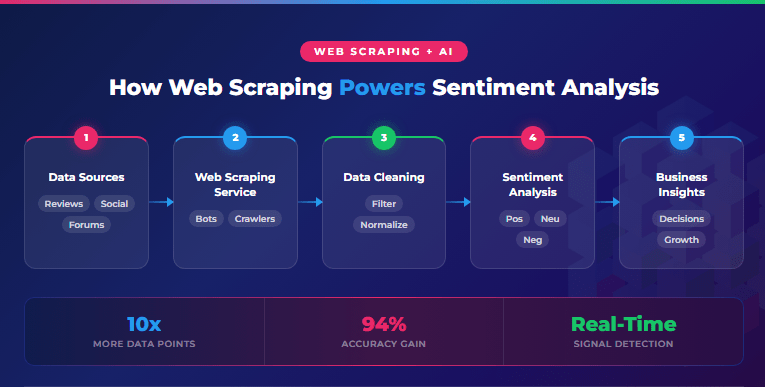
A professional automates the collection of publicly available text data — reviews, forums, social media posts, news articles — at a scale impossible to achieve manually. The result: richer, faster, more accurate sentiment insights.
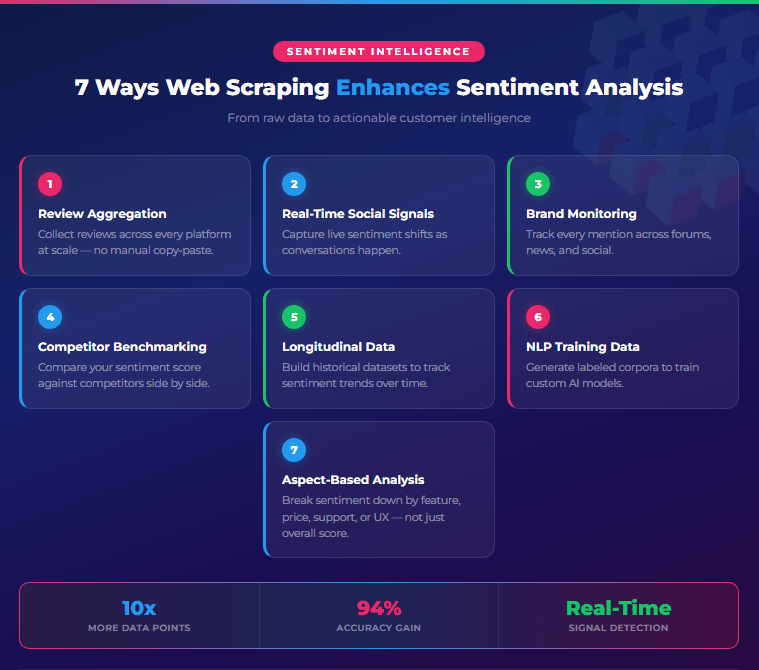
Here are 7 powerful ways web scraping enhances sentiment analysis.
1. Aggregating Reviews Across Multiple Platforms
Relying on a single review platform gives you a narrow view. Web scraping pulls customer reviews from Amazon, Yelp, Google Reviews, Trustpilot, and G2 simultaneously through , giving sentiment models a broader, more representative dataset. Instead of analyzing hundreds of reviews, you’re working with tens of thousands — which dramatically improves the accuracy of sentiment scores.
2. Capturing Real-Time Social Media Signals
Social media is where customers speak freely and immediately. Web scraping collects posts, comments, and replies from platforms like Reddit, Twitter/X, and niche forums in near real-time. This live stream of unfiltered opinion allows businesses to detect sudden shifts in sentiment — a product issue going viral, a PR crisis emerging — before it escalates.
3. Monitoring Brand Mentions Across the Web
Beyond structured review sites, your brand appears in blog posts, news articles, and discussion boards. A web scraping service continuously monitors these mentions and feeds them into your sentiment pipeline. This gives you a 360-degree view of brand perception that no survey or focus group can replicate.
4. Enabling Competitor Sentiment Benchmarking
Knowing your own sentiment score is useful. Knowing how it compares to competitors is powerful. Web scraping collects customer reviews and mentions for competing products, allowing you to run side-by-side sentiment comparisons as part of a broader strategy. If a competitor scores low on “ease of use” and you score high, that’s a marketing angle worth amplifying.
5. Building Longitudinal Sentiment Datasets
A single sentiment snapshot tells you how customers feel today. A longitudinal dataset — built through continuous scraping over weeks or months — tells you how sentiment is trending. Did a product update improve scores? Did a policy change trigger backlash? Time-series sentiment data answers these questions with evidence, not guesswork.
6. Improving NLP Model Training Data
Natural language processing (NLP) models used for sentiment classification require large, diverse, domain-specific training datasets. Web scraping generates exactly that: real customer language, in context, at volume. According to research published by the , model accuracy improves significantly when training data reflects the actual domain vocabulary — something scraped data provides natively.
7. Extracting Aspect-Based Sentiment at Scale
(ABSA) identifies how customers feel about specific product features — not just the product overall. For example: “The battery life is great, but the screen is disappointing.” Extracting this level of granularity requires massive text datasets. Web scraping supplies the volume needed to make ABSA statistically meaningful, enabling product teams to prioritize improvements with precision.
Why Data Quality Determines Sentiment Accuracy
Sentiment analysis is only as good as the data behind it. Inconsistent formats, duplicate entries, or scraped HTML noise can skew results significantly. A reliable web scraping service delivers clean, structured data through automated — stripping HTML artifacts, deduplicating entries, and normalizing text before it enters your sentiment pipeline. This preprocessing step is often the difference between actionable insights and misleading conclusions.
Web Scraping + Sentiment Analysis: Real-World Applications
- E-commerce brands scrape product reviews to detect quality issues before they impact return rates.
- SaaS companies monitor forum threads and review sites to prioritize feature requests by sentiment weight.
- Market research firms use scraped data to deliver sentiment-based competitive intelligence reports to clients.
- Healthcare organizations analyze patient reviews to identify service gaps and improve care quality.
How Scraping Pros Supports Sentiment Analysis Workflows
At Scraping Pros, we build custom web scraping solutions designed to feed sentiment analysis pipelines with clean, structured, high-frequency data. With over 15 years of experience, we’ve delivered scalable scrapers for clients across e-commerce, SaaS, finance, and healthcare — all fully compliant with data regulations and platform terms of service.
Whether you need a one-time dataset or a continuous data feed, our team delivers structured output in JSON, CSV, or directly into your database — ready for your NLP models.
Conclusion: Smarter Sentiment Starts with Better Data
Web scraping is the infrastructure that makes sentiment analysis work at scale. Without consistent, high-volume data collection, even the most sophisticated NLP model is operating blind. By integrating a professional web scraping service into your sentiment workflow, you gain faster insights, broader coverage, and the competitive intelligence to act before your competitors do.
Ready to power your sentiment analysis with reliable data? today.
