
In retail, price is the most immediate argument a consumer has for choosing or abandoning a purchase. But behind that visible number lies a real-time decision infrastructure: repricing algorithms, margin rules, seasonal strategies, and competitive responses that update multiple times a day. The problem for most retailers is not a lack of data — it is the speed at which that data loses its value.
We call this price signal decay: the degradation of the informational value of a price data point over time. In high-velocity categories like consumer electronics or fast fashion, a price captured four hours ago can be just as stale as one from last week. E-commerce price monitoring systems not designed for this speed do not merely produce late intelligence — they produce wrong decisions.
This article describes the technical architecture behind an e-commerce price monitoring system built to operate at real scale: tens of thousands of SKUs, multiple markets, high-pressure seasonal events, and regulatory environments that demand rigor in data handling. This is not an introduction to the topic. It is a guide for those who already understand the problem and need to know how to solve it properly.
1. Why Conventional E-commerce Price Monitoring Cannot Solve the Real Problem
Most price monitoring solutions on the market were designed for a slower e-commerce era. When algorithmic repricing was the exception and price changes happened once or twice a week, a system that scraped every 24 hours was adequate. That model no longer exists.
The Overnight Repricing Cycle
78% of price adjustments in highly competitive categories occur between 9 PM and 6 AM — what practitioners call the overnight repricing cycle. This is when the pricing algorithms of major retailers process the day’s data, adjust margins, and reposition key SKUs ahead of the next morning’s opening. An e-commerce price monitoring system that fails to cover that window with sufficient frequency is operating with a structural blind spot.
The Cost of Fixed-Frequency Monitoring
The second problem is economic. Monitoring 50,000 SKUs every 15 minutes carries a radically different infrastructure cost than doing so every 4 hours. Systems that apply a uniform frequency across their entire product base resolve the problem inefficiently: they either over-monitor products that do not require it, or under-monitor the ones that do.
The solution is not to choose a frequency — it is to implement dynamic crawl scheduling based on the historical volatility of each individual SKU. A product that changed price 40 times in the last 30 days needs monitoring every 15 minutes. One that has not changed in 6 months can be monitored every 6 hours. Intelligent architecture redistributes computational load according to where the actual risk lies.
The Normalization Problem: When the Same Product Has a Hundred Names
The third problem is semantic. Two retailers may list the same 55-inch television under completely different titles. Without an entity resolution engine that cross-references SKUs across sources by structural attributes — brand, model, technical specifications — the system generates invalid comparisons. In operational testing, the absence of semantic normalization pushes the false positive rate on price alerts above 30%. That means three out of every ten alerts reaching the pricing team is noise.
2. Seasonal Events: The Stress Test for Any E-commerce Price Monitoring Architecture
If there is a moment when a price monitoring architecture is truly put to the test, it is during major commercial events. Black Friday, Hot Sale, Cyber Monday, Mother’s Day, back-to-school, the Southern Hemisphere summer season. Each of these events compresses into hours what normally unfolds over weeks: mass price updates, limited-time promotions, last-minute bundles, and discounts that sometimes last fewer than 60 minutes.
The Anatomy of a Hot Sale in Latin America
Hot Sale — organized by the and its counterparts in Mexico, Colombia, and Chile — is one of the fastest-growing e-commerce events in the region. In Argentina, the 2024 edition generated over 150 billion pesos in sales across five days. During those days, the volume of price changes on participating platforms can multiply by eight compared to a normal trading day.
The challenge for an e-commerce price monitoring system is not simply capturing those changes. It is distinguishing between three types of signal that appear simultaneously: a genuine discount off the list price, an artificially inflated price set in the days before the event to manufacture a larger apparent discount during it, and a dynamic price responding in real time to demand. All three require at least 30 days of historical context to be interpreted correctly.
Without a 30-day historical reference window, 40% of discounts announced during events like Hot Sale or Black Friday cannot be verified as genuine reductions from the habitual selling price.
Black Friday in the United States and Spain: Two Different Dynamics
In the United States, Black Friday remains the highest-volume e-commerce event of the year, though its relative weight has declined as Amazon Prime Days and other retailer seasonal events have expanded. What has changed in the past three years is its duration: what was once a single day has stretched to a week, and in some cases two. This creates an extended pricing pattern where competitors adjust prices asynchronously, making the critical monitoring window as long as three weeks.
In Spain, Black Friday has a particularity that directly affects pricing strategy: it overlaps with the start of Christmas sales and with Singles’ Day (11/11), which established itself firmly in Spain after its global expansion from China. Spanish retailers operating across all three windows simultaneously need a system capable of distinguishing and tracking price signals for each one without contaminating data across categories.
Seasonality and the Asymmetry of Data
Seasonality presents a methodological trap that poorly designed monitoring systems cannot resolve: data asymmetry. During peak season, prices fall in demand-driven categories and rise in supply-constrained ones — for example, imported products with stock restrictions. Off-season, that logic partially reverses, but not symmetrically.
A robust e-commerce price monitoring system needs to incorporate seasonality models by category, not just by calendar. Consumer electronics follows a different cycle from apparel, which in turn differs from garden products or kitchen appliances. Applying a single seasonal model across all categories produces margin analyses that systematically underestimate risk during the highest-pressure competitive windows.
3. Technical Architecture: The Four-Layer E-commerce Price Monitoring System
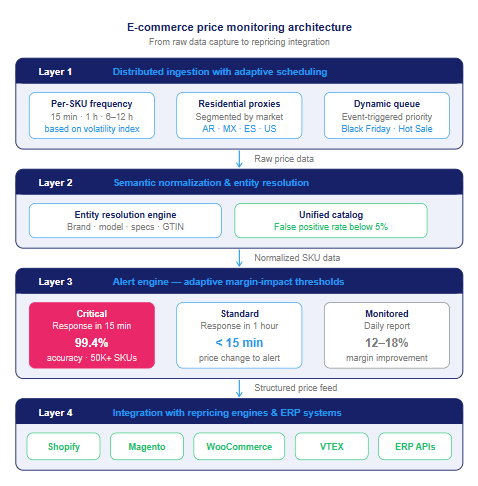
A designed to operate at real scale is not a more sophisticated scraper. It is a four-layer pipeline where each layer serves a specific function, and failures in any one of them degrade the quality of the intelligence that reaches the pricing team.
Layer 1: Distributed Ingestion with Adaptive Scheduling
The first layer handles data capture. Its function is to visit competitor product pages at the right frequency, at the right time, from the right access sources. This involves three simultaneous technical decisions.
- Per-SKU adaptive frequency: the system calculates a volatility index for each product based on the change history of the past 30 days. High-volatility products are visited every 15 minutes; medium-volatility, every hour; low-volatility, every 6 to 12 hours. This reduces infrastructure cost without sacrificing coverage where it matters.
- Region-segmented residential proxy rotation: retailers implement bot-detection measures that vary by country. A system accessing from data center IPs is detected and blocked. The use of residential proxies segmented by market — Argentina, Mexico, Spain, the United States — enables continuous access without coverage degradation.
- Dynamic queue prioritization: when an active commercial event is detected — via the system’s own calendar or price signals already in the pipeline — the scheduler recalibrates the scraping queue to increase frequency in the affected categories without reducing coverage across the rest of the catalog.
Layer 2: Semantic Normalization and Entity Resolution
Raw price data is not comparable across sources without a normalization process that resolves the ambiguity of natural language. Layer 2 takes the ingestion output and processes it through an entity resolution engine that cross-references SKUs by structural attributes: brand, model, part number, technical specifications, and — where available — GTINs (Global Trade Item Numbers).
The result is a unified catalog where each product has a canonical identity and all source variants are mapped to that identity. This step is what makes valid price comparison possible and what eliminates false positives from the alert layer. Our applies this same normalization logic across any catalog size.
For a widely adopted reference on structured product classification, see the .
Layer 3: Alert Engine with Adaptive Margin-Impact Thresholds
The most common error in price alert systems is operating with fixed percentage thresholds. A 3% change on a $10 product triggers the same alert as a 3% change on a $10,000 one. The difference in absolute margin impact is two orders of magnitude.
The system’s alert engine calculates the expected gross margin impact of each detected price change, accounting for the SKU’s historical sales volume and the category’s target margin. Alerts are classified into three priority levels: critical (15-minute response), standard (1-hour response), and monitored (daily report). System accuracy across a base of 50,000+ active products reaches 99.4%, meaning fewer than 1 in 167 alerts is a false positive.
| Metric | Value |
|---|---|
| Accuracy across 50,000+ active SKUs | 99.4% |
| Max time from price change to notification | < 15 min |
| Average gross margin improvement | 12–18% |
Layer 4: Integration with Repricing Engines and Management Systems
The system’s output is not a dashboard to be read: it is a structured feed that directly powers repricing engines. Layer 4 exposes integration APIs for e-commerce platforms — Shopify, Magento, WooCommerce, VTEX — and for ERP systems where margin rules coexist with cost and stock data.
This integration is what elevates e-commerce price monitoring to critical business infrastructure. A retailer that connects the price intelligence feed to their repricing engine can respond to a competitive move without manual intervention, within the rule framework their pricing team has defined. Under conditions of high competitive pressure, that response speed is the difference between defending a margin and losing it. Learn more about our and how it feeds directly into this layer.
4. Compliance and Data Protection in E-commerce Price Monitoring
One of the most persistent misconceptions about web scraping is treating it as an activity that operates in a regulatory vacuum. The opposite is true: scraping publicly available e-commerce data, when conducted correctly, is a legal, ethical, and increasingly well-regulated practice across the world’s major markets.
The Public Data Principle and Its Limits
A product price published on an e-commerce site is public information. It requires no authentication to access; it is available to any user without restriction. This distinguishes price monitoring from the scraping of private or protected data, which is treated entirely differently under any regulatory framework.
The relevant boundary lies not in what data is captured, but in how it is captured and what is done with it. A system that overloads the target site’s servers to the point of causing a service outage may be treated as a cyberattack under legislation such as the in the United States. A system that respects crawl timing, does not access areas restricted by robots.txt, and operates within reasonable frequency limits raises no legal issues in any of the markets where Scraping Pros operates.
GDPR, CCPA, and Latin American Data Protection Laws
When e-commerce price monitoring is combined with consumer behavior analysis or integrated with customer databases, the regulatory framework becomes more demanding. The and the California Consumer Privacy Act (CCPA) establish principles of data minimization, purpose limitation, and data subject rights that apply to any system processing personal information, regardless of where the company is based.
In Latin America, countries including Argentina (Law 25,326), Brazil (LGPD), Mexico (Federal Law on Protection of Personal Data Held by Private Parties), and Colombia (Law 1581/2012) each have their own frameworks that a well-managed regional operation must take into account.
The key distinction holds across every jurisdiction: publicly available price data is scrapeable; user behavior data or personal customer information is protected data. A well-designed price monitoring system never touches the second category.
Scraping Pros and the Principle of Responsible Architecture
Scraping Pros’ technical architecture incorporates compliance principles by design — not as an afterthought. This includes adherence to robots.txt directives where applicable, per-domain configurable rate limiting, full anonymization across data pipelines, and documentation of the legal basis for each scraping operation. For clients in regulated sectors, this is a prerequisite for any engagement. In a context where GDPR violations can carry fines of up to 4% of annual global turnover, that certainty carries concrete economic value. See how we approach this in our .
5. E-commerce Price Monitoring in Action: Use Cases by Region
Latin America: The Electronics Retailer and the Pressure of Commercial Events
An electronics retailer operating across Argentina, Chile, and Mexico was monitoring 28,000 active SKUs against twelve competitors using a fixed-frequency system set to every four hours. The problem became critical during Hot Sale: their main competitor was updating prices twice a day in key categories, and the pricing team only found out the following morning.
After implementing a dynamic crawl scheduling system with adaptive frequency and commercial event prioritization, competitive response time dropped from four hours to eleven minutes during the Hot Sale period. In the quarter following the event, gross margin improvement in monitored categories reached 14%. The system also detected a pre-event price inflation pattern in competitors during the week before the event — allowing the pricing team to hold their position rather than follow that movement, and to enter the event with a stronger value proposition.
United States: The Office Supplies Distributor and Inverted Seasonality
A wholesale distributor of office consumables in the North American market faced an asymmetric seasonality problem: their prices were competitive during back-to-school season (August–September), but in the first quarter of the year they were losing sales in categories where they had no visibility into their main competitors’ pricing moves.
Implementing an e-commerce price monitoring system with category-level seasonality models — rather than a single shared calendar — revealed that their primary competitors were adjusting prices in professional stationery categories during the second week of January, coinciding with the close of corporate budget cycles. That insight, which the sales team had not detected in five years of operation, enabled a proactive pricing strategy for that window. In the following season, the distributor captured an additional 9% market share in the affected categories.
Spain: The Multi-Brand Fashion Marketplace and Three Simultaneous Events
A multi-brand fashion marketplace operating in Spain faced the challenge of monitoring prices during the convergence of three commercial events in November: Singles’ Day (11/11), Black Friday, and the start of the Christmas sales period. Each event carried its own pricing logic — 11/11 focused on accessories and basics, Black Friday on seasonal garments, and Christmas sales on prices that descended progressively over time.
The e-commerce price monitoring system segmented the catalog into three groups by event affinity, monitoring each with greater intensity during its corresponding window. This reduced infrastructure costs by 34% compared to uniform monitoring, while maintaining full coverage during peak competitive pressure. The buying team used the price intelligence to make stock replenishment decisions ahead of each event, avoiding stockouts in the categories with the highest competitive activity.
Frequently Asked Questions About E-commerce Price Monitoring
How often should prices be monitored in e-commerce?
It depends on the SKU’s historical volatility. In highly competitive categories, the operational standard is every 15 to 30 minutes. For niche products with low competitive activity, every 6 to 12 hours is sufficient. Per-SKU adaptive frequency is always more efficient than uniform scheduling.
Is web scraping of e-commerce prices legal?
Yes. Prices published without authentication are public data, and capturing them is legal in the U.S., the EU, and Latin America when operated with responsible architecture. Regulatory risk arises only if personal data or user behavior information is processed.
What is the difference between price monitoring and competitive intelligence?
Monitoring is the data layer: capturing what price a product carries at a given moment. Competitive intelligence is the analysis layer: understanding the patterns, logic, and triggers behind those prices. A mature e-commerce price monitoring system integrates both. Our covers both layers.
How does the system scale beyond 100,000 SKUs?
Through distributed architecture, adaptive scheduling, and a prioritization engine that concentrates computational resources on the highest-risk products. The key is ensuring that processing load is proportional to the value of the information, not to the total size of the catalog.
How long until margin impact becomes visible?
Initial indicators typically appear within two to three weeks, especially if a commercial event falls in that window. Sustained structural impact is visible within the first full quarter of operation, with typical improvements of 12% to 18% in monitored categories.
Ready to Turn Price Data into Competitive Advantage?
At Scraping Pros, we design and implement custom e-commerce price monitoring systems for retailers and brands operating in high-competition markets. From ingestion architecture to repricing engine integration, we make sure price intelligence reaches your team in under 15 minutes.
Need reliable data at enterprise scale?
At Scraping Pros we build custom web scraping solutions for enterprise teams. Tell us about your data challenge.
