
The question separating market leaders from laggards is not whether to capture web data — it is which decision to connect it to first.
In retail, a 15-minute pricing cycle versus a weekly one is measurable in margin points. In financial services, web-sourced alternative data generates investment signals 4–8 weeks ahead of traditional channels. In Latin American real estate, scraping is not a competitive advantage — it is the only viable instrument for market intelligence.
This post maps the web scraping use cases driving measurable impact across four verticals — and explains which web scraping use cases deliver the fastest time-to-value in North America, Europe, and Latin America.
Web Scraping Use Cases by Industry: Adoption, Applications, and ROI
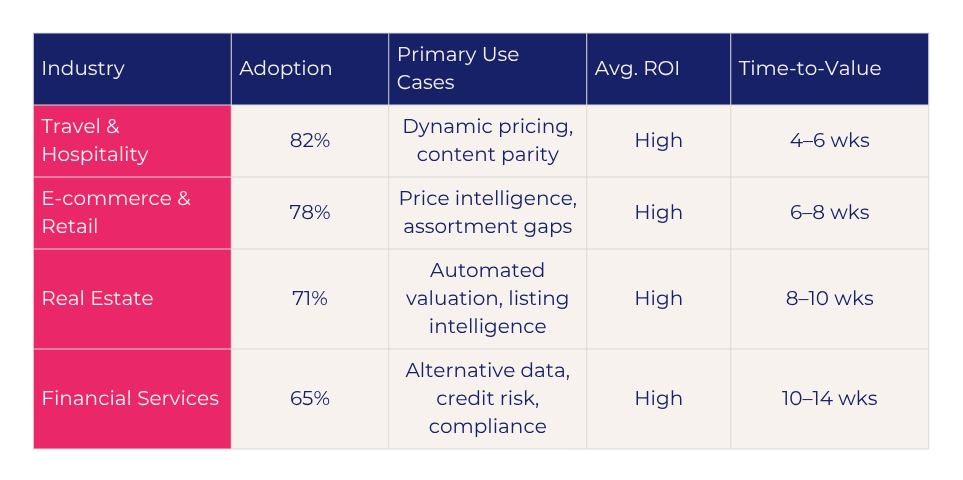
Source: Scraping Pros deployment data across 200+ enterprise clients, 2025–2026.
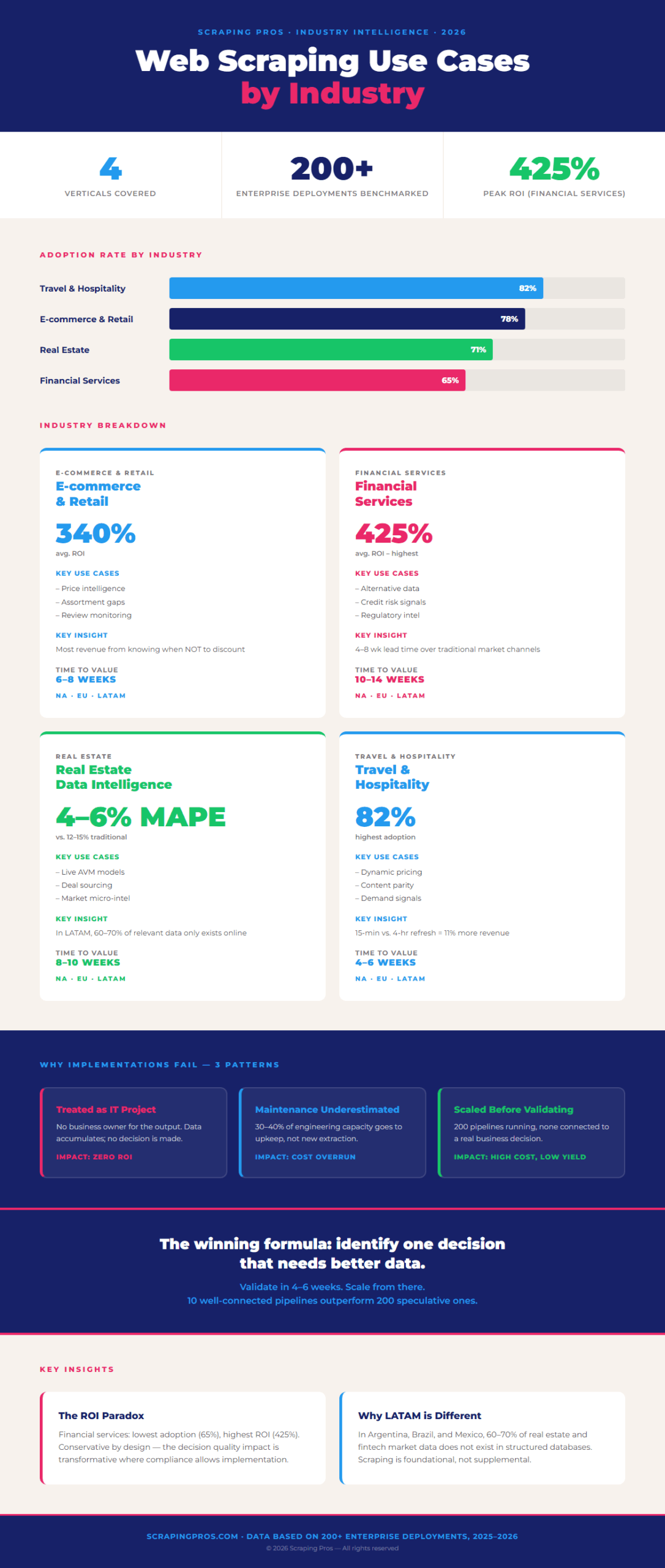
The pattern in the table is not accidental. Financial services has the lowest adoption rate at 65% and the highest ROI at 425%. Travel has the highest adoption at 82% and operates on the most commoditized value proposition.
Each section below addresses one vertical with the specificity that generic market surveys don’t provide.
1. E-commerce and Retail Use Cases
Retail’s 78% adoption rate and 340% average ROI reflect a straightforward commercial reality: every product that can be priced can be monitored. The retail web scraping use cases generating the most value have moved past entry-level price tracking into applications that are harder to replicate.
Price Intelligence at Scale
In North American e-commerce, retailers operating across 40,000+ SKUs use web scraping to monitor pricing at the bundle and availability level — how competitors package products, at what price points, with what shipping conditions.
The resulting dataset feeds dynamic pricing engines that make repricing decisions in under 15 minutes.
The counterintuitive finding from production deployments: the majority of revenue impact does not come from lowering prices. It comes from knowing when not to lower them.
When a competitor goes out of stock and demand shifts, a retailer with real-time data can hold margin while the market corrects. A retailer on weekly pricing cycles misses that window entirely.
In European fashion retail, one mid-market apparel operation reduced promotional margin erosion by 21% after implementing price intelligence across 12 competitor domains. The key finding: 34% of their promotional discounts were applied to categories where no competitor had moved.
Assortment Gap Analysis
A buying team that can see which product categories competitors are expanding into — at what price points, with what customer ratings — has a structural lead on identifying market white space.
In Brazil and Mexico, where e-commerce grows at 22–28% annually but centralized market data lags significantly, this web scraping use case has particular impact. Organizations that implemented systematic assortment gap analysis in these markets report compressing new category identification cycles from 6–8 weeks to 48–72 hours.
Review Intelligence
The organizations capturing competitive advantage from reviews are not the ones with the highest volume. They are the ones monitoring review patterns across the entire market category in real time.
In consumer electronics across North America and Europe, this approach has detected emerging product quality issues an average of three weeks before those issues surface in return data. That lead time provides room for procurement adjustments, customer communication strategies, and service preparation.
Related:
2. Financial Services Web Scraping Applications
The sector with the lowest adoption rate produces the highest ROI. Financial services web scraping use cases are more conservative to implement because compliance and audit requirements are more demanding — but when structured correctly, the decision-quality improvement is transformative.
When financial services organizations implement web scraping use cases correctly — with the governance architecture the sector requires — the decision-quality improvement is transformative.
Alternative Data for Investment Signals
In asset management across North America and Europe, alternative data sourced from web scraping has become a standard component of quantitative investment strategies.
The signal types that have proven most durable are not the obvious ones:
- Job posting data: An unusual increase in supply chain engineering hires at a logistics company is a credible 6-week leading indicator of operational expansion — appearing on the careers page well before any official disclosure.
- Distributor inventory levels: Published on regional e-commerce portals, these reveal supply chain dynamics before earnings reports.
- Supplier pricing updates: On B2B procurement platforms, these signal cost pressure before it hits margins.
Firms incorporating these signals report anticipation windows of 4–8 weeks versus publicly available market data. According to , over 70% of hedge funds now use some form of web-sourced data in their investment process.
A European asset management operation running alternative data programs across 400+ web sources found that signals derived from job postings and distributor inventory data generated statistically significant alpha in three out of four backtest periods over a 36-month window. The infrastructure investment represented less than 8% of the alpha generated.
Credit Risk Enhancement
In Latin American fintech markets — where formal credit histories are sparse and SME lending represents a significant underserved segment — web scraping provides behavioral signals that complement or replace traditional credit bureau data.
Signals monitored include:
- Age and maintenance quality of a business’s web presence
- Product review trajectories on regional e-commerce platforms
- Frequency of catalog and pricing updates as a proxy for operational activity
- Presence across multiple distribution channels
Lenders incorporating these signals into underwriting models report 23% reductions in default rates on SME portfolios compared to models relying exclusively on traditional credit data.
Regulatory Compliance Monitoring
For institutions operating across multiple jurisdictions in Europe and Latin America, regulatory change monitoring is a continuous operational requirement.
Central bank rate announcements, competitor tariff schedule updates, changes to consumer credit disclosure requirements, modifications to AML frameworks — this information is public and distributed across dozens of regulatory websites.
Monitoring it manually at the required frequency is prohibitive. Web scraping infrastructure that monitors regulatory sources continuously and delivers structured alerts on content changes eliminates the risk that arises from delayed detection.
Related:
3. Real Estate Web Scraping Use Cases
Real estate operates on information asymmetry. The party with better data on pricing trends, inventory dynamics, and demand signals wins the transaction. Real estate web scraping use cases have moved from competitive advantage to market entry requirement — and in markets like Latin America, they are the only viable instrument for intelligence at scale.
Next-Generation Automated Valuation Models
Traditional automated valuation models depend on historical transaction data — measuring where the market was, not where it is.
AVMs built on web scraping combine historical transaction data with live listing feeds:
- Current asking prices
- Days on market
- Price reduction frequencies
- Inventory depletion rates by micro-area
The resulting models reduce mean absolute percentage error from a typical 12–15% on traditional AVMs to 4–6% on scraping-augmented models. , AVM accuracy is among the top three factors influencing institutional real estate investment decisions.
In Latin American markets — Argentina, Colombia, Chile, and Mexico are the most developed contexts — this is a foundational requirement, not an incremental improvement. In these markets, 60–70% of relevant real estate data does not exist in structured databases. It lives in portal listings, developer websites, and regional classifieds.
For any organization attempting to build market intelligence in these environments, web scraping is the only viable primary data source.
Investment Opportunity Detection
In competitive markets across the United States and Western Europe, the window between a property appearing on the market and being correctly priced can be as short as 24–48 hours.
Investment operations that monitor 50+ listing portals simultaneously — with alerting logic that flags properties meeting specific criteria within minutes of listing — operate in a categorically different information environment.
One investment operation active across three European markets implemented systematic listing monitoring and identified 34% more acquisition opportunities meeting its investment criteria over an 18-month period, with no increase in deal-sourcing headcount.
Related:
4.Travel and Hospitality Web Scraping Examples
Travel has the highest adoption rate at 82% because the market understood a structural reality earlier than other verticals: pricing in travel is inherently dynamic, supply is fixed, and the gap between a responsive pricing strategy and a static one is measured directly in revenue.
Dynamic Pricing Intelligence
Rate monitoring is the entry point. The organizations generating sustained revenue advantage have moved to interpreting why competitors price as they do — and anticipating when they will change.
An operator that detects a competitor blocking inventory in a high-demand period and interprets that as a yield adjustment signal is operating at a different level than one that observes rate changes after they happen.
A property management group operating across North America and the Caribbean moved from 4-hour to 15-minute competitive rate updates during peak demand periods — events, holidays, conferences. In high-demand windows, that difference in refresh frequency translated to 11% in captured revenue in the first operating year.
In Latin American markets — Brazil, Argentina, Mexico — where demand spikes are sharper and booking windows shorter, the lead time from pricing signal to pricing action is even more commercially significant.
Content Parity Monitoring
Distribution agreements between hotel chains and OTAs in the European market typically contain rate and content parity clauses. Monitoring compliance manually across 40–80 active channels is operationally untenable.
Web scraping use cases in this context include continuous parity checks that flag channel-level deviations in:
- Price
- Property description
- Image count
- Room category availability
In North American hospitality markets, this has evolved to include detecting unauthorized package combinations or property description modifications that affect booking conversion.
Demand Signal Detection
Before prices move, signals appear: event announcements, the rate at which competing properties reduce available inventory, shifts in search patterns on public booking tools.
Revenue management teams that monitor upstream signals and price preemptively capture yield that reactive teams leave on the table. According to , hotels using automated competitive intelligence tools outperform manual monitoring operations by an average of 9% in RevPAR during high-demand periods.
Across hospitality deployments in North America, Europe, and Latin America, organizations that moved from 4-hour to sub-30-minute data refresh cycles reported average revenue uplift of 8–14% in high-competition periods.
Related:
Why Some Companies Capture the ROI and Others Don’t
The figures cited in this post — 340% in retail, 425% in financial services — are not universal. They are outcomes of mature, well-structured web scraping use cases with clear business ownership and validated pipelines.
Organizations that implement web scraping and fail to reach those outcomes share three patterns:
They treat scraping as an IT project rather than a business capability.
The output of a scraping pipeline needs a business owner — someone accountable for translating extracted data into a decision. When that accountability is absent, data accumulates in storage without influencing any process. The technical implementation may be flawless. The business impact is zero.
They underestimate the maintenance requirement.
In mature scraping operations, 30–40% of engineering capacity is consumed by maintenance — not new extraction. Sites change, anti-bot systems evolve, selectors break. Organizations that plan only for the build phase encounter a growing maintenance debt that eventually consumes the team’s bandwidth.
They scale before validating.
The temptation to extract everything before proving that anything is actionable results in systems with high cost and low yield. The organizations with the best ROI outcomes started with a single high-impact use case, validated value delivery within 4–6 weeks, and scaled from a proven foundation.
The most consistent predictor of scraping ROI is not the sophistication of the extraction technology. It is whether the organization identified a specific decision that needed better data before they built anything.
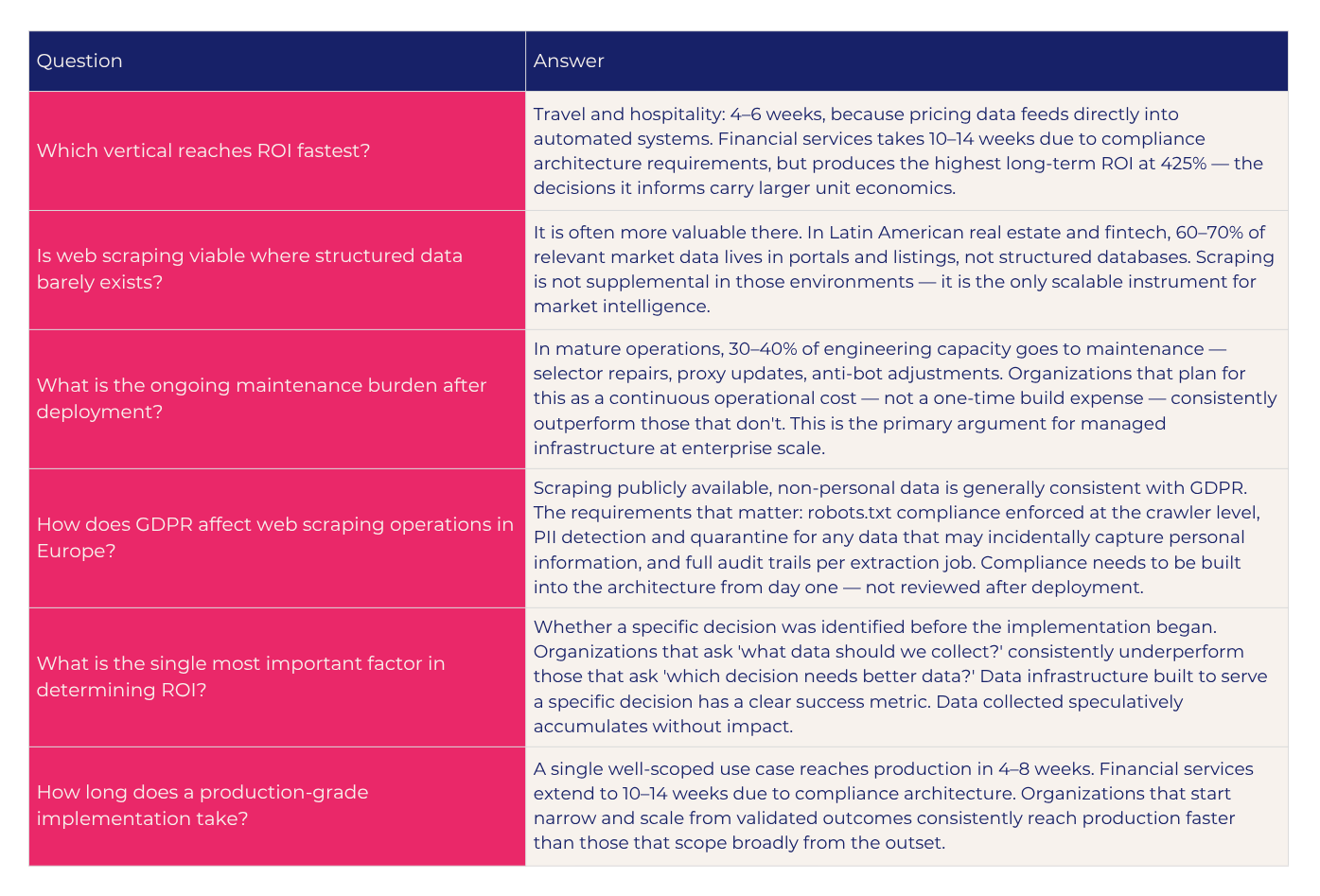
Frequently Asked Questions
The questions that consistently arise when organizations evaluate web scraping as a strategic capability.
Ready to Identify Your Highest-Impact Web Scraping Use Case?
The organizations in this post did not start by implementing web scraping across four verticals simultaneously. They started with one use case, one decision, and one measurable outcome — and scaled from there.
Scraping Pros works with enterprise teams across e-commerce, financial services, real estate, and travel to scope, build, and operate the web scraping use cases that connect directly to business decisions — with infrastructure your team doesn’t have to maintain.
Start with one decision. Build from there.
— we’ll identify the extraction pipeline with the shortest path to measurable business impact for your vertical.
scrapingpros.com |
Need reliable data at enterprise scale?
At Scraping Pros we build custom web scraping solutions for enterprise teams. Tell us about your data challenge.
