
Are you looking for a Bright Data alternative because you need web data, not another platform to operate? Bright Data is one of the largest web data companies in the world, with a broad proxy network, scraping APIs, ready-made datasets and a managed data service. For many teams it is a solid choice. Others find they need something different: a smaller minimum spend, a provider that builds and maintains every scraper for them, or a closer working relationship with the engineers behind their data. This guide explains what Bright Data offers, when an alternative makes sense, and what to evaluate before switching.
At Scraping Pros we run a fully managed web scraping service, so we are one of those alternatives. We’ll try to be fair about both options.
What Bright Data Offers
Bright Data covers almost every way of getting web data:
- Proxy infrastructure — residential, datacenter and mobile IP networks used by developers who build their own scrapers.
- Scraping APIs and browser tools — for teams that want to run extraction themselves without managing proxies directly.
- Datasets — pre-collected data for popular websites, available to purchase.
- Fully Managed Data Acquisition Services — custom data collection where Bright Data builds and runs the scrapers.
For its managed service, Bright Data publishes its pricing: standard projects start at $1,000 per month (with a $1,000 monthly minimum), plus a one-time setup fee of $500 per standard scraper and usage fees per 1,000 requests. The standard project includes one scraper, 250,000 records, scraper maintenance and support, and data is delivered as JSON, NDJSON or CSV via webhook or API. (Source: Bright Data’s managed services pricing page, checked October 2026. Always confirm current pricing on their website.)
That breadth is Bright Data’s main strength: if you need infrastructure, APIs and data from one vendor, it’s hard to match.
Why Teams Look for a Bright Data Alternative
The reasons we hear most often are practical, not technical:
- Budget and minimums. Smaller or mid-size projects may not justify a $1,000+ monthly minimum plus setup and usage fees.
- They don’t want to operate tools. Proxies and APIs are powerful, but someone on your team still has to build, run and fix the scrapers.
- They want one predictable monthly price. Usage-based components make it harder to forecast spend when volume or frequency changes.
- They need custom, messy sources. Niche websites, PDFs, regional marketplaces or unusual fields often need hands-on engineering rather than a standard product.
- They want a direct relationship. Some teams prefer working closely with the people who build and maintain their feeds.
None of these mean Bright Data is the wrong choice. They mean the right choice depends on what your team wants to own.
Platform vs. Managed Service: The Real Decision
Most “Bright Data vs. X” comparisons mix two different questions. The first is whether you want a platform (infrastructure and tools your team uses) or a managed service (a provider that delivers finished data). The second is which provider to choose within that category.
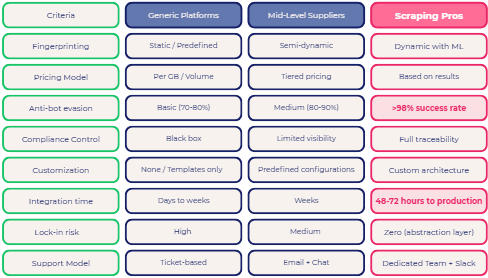
In short: with a platform, your team builds and fixes the scrapers and pays for usage; with a managed service, the provider builds and maintains them and you receive clean data on a schedule, in your format.
If you have a data engineering team that wants control over every request, a platform like Bright Data’s is a strong fit. If you want the data and not the work, a managed service — Bright Data’s own, or an alternative — is the comparison that matters.
What to Evaluate in a Bright Data Alternative
Whichever providers you compare, ask the same questions:
- Total monthly cost for your actual scope, including minimums, setup fees and usage fees.
- Maintenance: who fixes the scrapers when a website changes, and how fast?
- Coverage: can they handle your hardest sources — marketplaces, regional sites, documents?
- Data quality: how are completeness and accuracy checked before delivery?
- Delivery: which formats and destinations are included (CSV, JSON, Excel, API, cloud storage)?
- Compliance: which data they collect, how, and what they won’t collect.
- A sample: can you see your own data before signing?
A sample of your own sources is the most reliable comparison you can make — much more useful than any feature list.
How Scraping Pros Works as an Alternative
Scraping Pros is a fully managed web scraping service. We build, run and maintain the extraction for you, and you receive clean data in the format you need.
- Published monthly plans. Growth from $399/month, Business from $699/month, and custom Enterprise pricing — see our pricing.
- Maintenance included. When a website changes, we fix the extraction; you don’t open tickets or rewrite code.
- Delivery your way. CSV, JSON, Excel or API, on the schedule your team needs.
- A free data sample and a quote within 24 hours, so you can evaluate the data before committing.
- Compliance-first approach. We work with publicly available data and align projects with regulations such as GDPR and CCPA.
Our process has three stages:
- Discovery. We review your sources, fields, volume and frequency, assess feasibility and agree on the output format.
- Implementation. We build the extraction, deliver a sample, adjust it with your feedback and connect delivery to your systems.
- Operation. We monitor every run, fix changes on target websites and adapt the feed as your needs grow.
When Bright Data Is Still the Better Choice
To be fair, Bright Data may fit better if:
- Your team wants to build and control its own scrapers on top of a large proxy network.
- You need off-the-shelf datasets for popular websites rather than custom collection.
- You want infrastructure, APIs and managed services from a single large vendor.
- Your volume and budget comfortably exceed managed-service minimums.
How to Switch Without Losing Data
If you decide to move from any provider to another, a few steps avoid gaps:
- Document your current feeds: sources, fields, frequency and delivery format.
- Run both in parallel for two to four weeks and compare completeness and accuracy.
- Keep the same output schema so dashboards and pipelines don’t break.
- Switch delivery only after the new feed has matched or improved on the old one.
- Keep historical data from your previous provider so trends stay continuous.
Action Items
- Decide whether you need a platform or a managed service.
- Write down your real scope: sources, fields, volume and frequency.
- Ask every provider for the total monthly cost, including minimums and fees.
- Request a sample of your own data from at least two providers.
- Compare samples on completeness, accuracy and ease of use.
- Plan a parallel run before switching.
FAQ
What is the best Bright Data alternative?
It depends on what you need. If you want infrastructure and tools, look at other platforms. If you want finished data without operating scrapers, compare managed web scraping services on total cost, maintenance, delivery and a sample of your own data.
How much does Bright Data’s managed service cost?
According to its pricing page (checked October 2026), standard managed projects start at $1,000 per month with a $1,000 monthly minimum, plus $500 setup per standard scraper and usage fees. Confirm current pricing on Bright Data’s website.
Is a managed web scraping service cheaper than a platform?
Not always in subscription cost, but often in total cost once you include the internal time needed to build, maintain and clean data yourself.
Can I switch providers without losing my historical data?
Yes. Keep your historical files, keep the same output schema and run both providers in parallel before switching.
Compare us with your own data. Request a free data sample and a quote within 24 hours, or see our plans.
