
In today’s competitive business environment, creating accurate and data-driven buyer personas is crucial for effective marketing strategies. Traditional methods — surveys and focus groups — are valuable but time-consuming and limited by sample size.
The advent of web scraping has revolutionized how businesses gather data, enabling more comprehensive and actionable buyer personas. This article explores how automated data collection can enhance your persona development process and improve decision-making in marketing and sales.
What is Web Scraping?
Web scraping is an automated technique used to extract large amounts of data from websites and convert it into a structured format for analysis. This process involves crawling websites to gather publicly available information, which can then be processed for market research, lead generation, competitive intelligence, and customer analysis.
According to Mozilla Developer Network’s guide on HTTP and data fetching, understanding how data is structured and retrieved from the web is foundational to building any automated data pipeline — which is exactly what modern scraping solutions are built on.
For businesses, this offers an efficient way to gather relevant data from a wide array of sources, enabling informed decisions based on real-time insights.
Why Buyer Personas Are Important for Your Business
Buyer personas are semi-fictional representations of your ideal customers based on real data about demographics, behaviors, motivations, and challenges. They help businesses understand their target audience more deeply, ensuring that marketing efforts are tailored to the right people.
Key reasons buyer personas matter:
- Accurate Targeting: Identify the right audience for more precise campaign targeting
- Content Relevance: Create content that resonates, driving engagement and conversions
- Informed Decision-Making: Build a data-driven foundation for products, services, and strategy
- Effective Communication: Craft messages around real pain points, fostering trust and loyalty
- Improved ROI: Reach the right people with tailored messaging and maximize marketing spend
5 Proven Ways Web Scraping Improves Buyer Persona Creation
Developing buyer personas used to rely on surveys and interviews — time-consuming, costly, and often incomplete. Automated data collection gives businesses access to vast amounts of information from multiple online sources to create more accurate and dynamic personas.
1. Customer Sentiment Analysis
One of the most powerful applications is sentiment analysis. By collecting reviews, comments, and social media mentions, businesses can assess whether customer sentiment is positive, negative, or neutral.
Scraping product reviews from platforms like Amazon or Yelp reveals what customers love or dislike about a product or service. These sentiments refine buyer personas by surfacing customer expectations, pain points, and motivations — helping businesses identify unmet needs and improve their offerings.
The Harvard Business Review’s research on customer intelligence confirms that companies leveraging real customer feedback data outperform peers in customer satisfaction and retention.
2. Social Media and Online Behavior Tracking
Automated data collection allows businesses to track customer behaviors across platforms — social media, forums, and review sites. By collecting this data, businesses gain a clearer understanding of customer interests, preferences, and interactions.
Gathering data from platforms like LinkedIn, Reddit, or niche industry forums reveals what people are discussing in real time — providing valuable insight into preferences and concerns. This helps refine buyer personas based on genuine online engagement patterns.
3. Demographic and Psychographic Insights
Extracting publicly available information from various websites uncovers demographic and psychographic data — customer age, location, occupation, interests, and social behavior patterns.
For instance, data from regional review platforms reveals the preferences of customers in a specific area, enabling hyper-targeted personas that reflect real needs. This level of specificity is difficult to achieve through traditional survey methods alone.
4. Competitive Intelligence
Monitoring competitor websites and social media platforms provides insight into how competitors engage with customers, which products they promote, and how they position themselves in the market.
Understanding these strategies allows businesses to create more refined buyer personas that reflect the broader market landscape — ensuring they stay competitive and relevant. For a framework on how to analyze competitor positioning, Semrush’s competitive research methodology is a widely cited industry resource.
5. Real-Time Trend Detection
Unlike static surveys, automated data collection continuously monitors online sources. This means buyer personas can be updated as customer needs and preferences evolve — not just once a year during a planning cycle.
Daily monitoring of industry forums and review platforms surfaces emerging trends, allowing marketing teams to adjust strategies proactively rather than reactively.
Key Benefits of Automated Data Collection for Persona Development
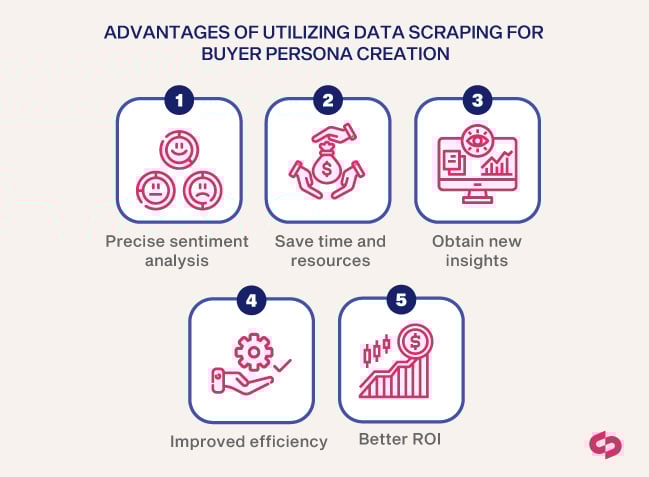
Increased Efficiency and Scalability
Traditional persona development requires significant time and resources. Automation allows businesses to gather large amounts of data quickly, creating and refining personas in a fraction of the time — staying agile in a fast-moving market.
Cost-Effective Research
Manual data collection is costly, especially when outsourcing to research firms. Automation reduces the need for manual labor, freeing resources to invest in other areas of marketing and customer acquisition.
Better Marketing and Sales Alignment
Accurate, data-driven personas improve collaboration between marketing and sales teams. Marketing crafts content that resonates; sales tailors outreach accordingly. This alignment leads to more effective lead generation and a smoother customer journey.
Case Studies: How Leading Companies Use Web Scraping for Buyer Personas
Amazon
Amazon tracks user behavior — searches, clicks, and purchases — to create detailed buyer profiles and recommend products tailored to individual preferences. This personalized approach has significantly boosted sales and customer loyalty.
Netflix
Netflix monitors user ratings, reviews, and viewing habits to fine-tune its recommendation system, delivering content that aligns with user preferences and maximizing engagement on the platform.
LinkedIn analyzes user profiles, connections, and activity patterns to suggest relevant connections, job opportunities, and content — creating a more personalized and valuable experience.
Internal Resources
Want to put this into practice for your business?
- 🔗 Explore our Web Scraping Solutions — Industry-specific pipelines for retail, fintech, and market intelligence
- 🔗 See our Web Scraping Pricing Plans — Growth, Business, and Enterprise tiers starting from $399/mo
- 🔗 Try our Free API — Test our infrastructure before committing
- 🔗 Contact our team — Schedule a free technical audit
Conclusion: The Future of Buyer Persona Creation
Automated data collection is a game-changer for creating and refining buyer personas. By automating data gathering, businesses access insights from a variety of online sources — producing more accurate, dynamic, and actionable personas.
With the ability to track customer sentiment, monitor competitor activity, and analyze online behavior, businesses can stay ahead of the curve and improve marketing strategies year-round.
Scraping Pros offers customized solutions that streamline this process and provide real-time, structured data to fuel smarter decisions. Explore our services today to take your persona development to the next level.
FAQ: Web Scraping for Buyer Persona Creation
What types of data can be collected for buyer personas?
Demographic data, behavioral patterns, product reviews, social media mentions, competitor positioning, and real-time trend signals — all gathered automatically from public online sources.
Is automated data collection legal?
Collecting publicly available data is generally permitted. Scraping Pros follows compliance protocols including robots.txt rules, frequency limits, and data anonymization to ensure ethical and lawful extraction.
How often should buyer personas be updated using scraped data?
Best practice is to review personas quarterly, with continuous monitoring for fast-moving industries. Real-time data pipelines allow for ongoing updates rather than annual refreshes.
How does this compare to traditional survey-based persona research?
Surveys are limited by sample size and response bias. Automated data collection draws from millions of real interactions — providing a more representative and objective view of customer behavior.
